
Unitree G1 Edu Ultimate D Humanoid Robot with 5 Finger Hands with Tactile Sensor (G1EDU-U6)

The Unitree G1 EDU Ultimate D, formally designated G1 EDU U6 (also appearing as G1EDU-U6), is the highest-capability production configuration in Unitree Robotics' G1 humanoid robot family. It represents the apex of the G1 EDU series — the configuration where Unitree's bipedal locomotion platform, NVIDIA Jetson Orin AI compute, and the most advanced dexterous hand available in the G1 lineup converge in a single platform.

In stock

BRAND:
UNITREE ROBOTICS
MODEL:
G1 EDU ULTIMATE D
PART #:
G1EDU-U6
ORIGIN:
China
Warranty:
18 MONTHS
AVAILABILITY:
SUBJECT TO AVAILABILITY
SKU:
Unitree-G1-Edu-U6
US$73,900.00
US$69,500.00
Loading...

Unitree G1 Edu Ultimate D Humanoid Robot with 5 Finger Hands with Tactile Sensor (G1EDU-U6)
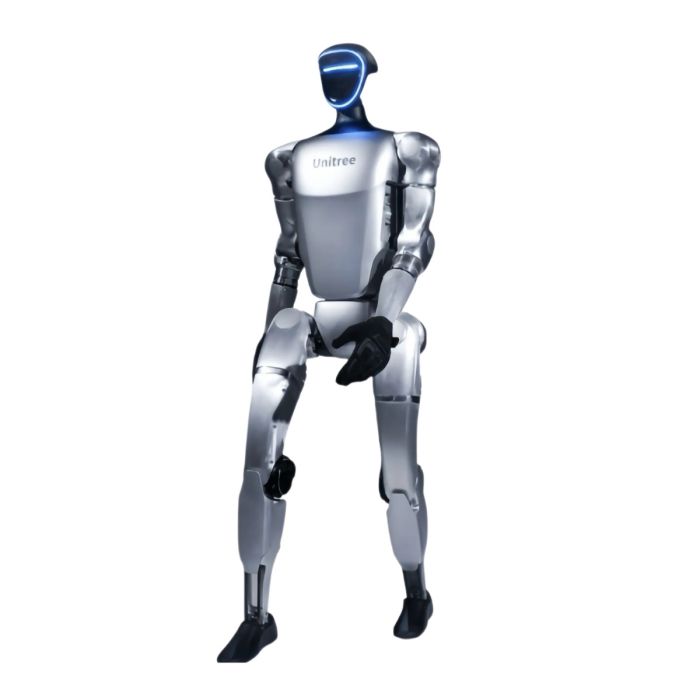
The G1 EDU Ultimate D features 41 total degrees of freedom, dual Inspire five-finger dexterous hands (RH56DFQ-2R right and RH56DFQ-2L left, also referenced as the Inspire RH56DFTP in some distributor listings) with 17 tactile sensors per hand, and upgraded dual encoders per joint that provide finer motion tracking and feedback than the U5 configuration's single-encoder design. It is powered by the NVIDIA Jetson Orin NX 16GB (100 TOPS) compute platform alongside an 8-core CPU, a LIVOX MID-360 3D LiDAR, an Intel RealSense D435i depth camera, and a local air cooling system for sustained operational stability under high-compute workloads. The battery is a quick-release 13-series 9,000 mAh lithium pack providing approximately two hours of runtime.

Design and Physical Features

Physical Platform: Shared G1 Frame

The G1 EDU Ultimate D uses the standard G1 frame: approximately 127 to 132 centimeters in standing height and approximately 35 kilograms with battery. The foldable design reduces the transport configuration to approximately 69 centimeters, enabling single-operator transport without specialized equipment. The aluminum alloy structural frame provides the rigidity needed to support the U6's 41-DOF actuation system while maintaining the compact, portable form factor that distinguishes the G1 from full-size humanoids.

The local air cooling system — confirmed in OpenELAB's and OpenELAB Inc.'s product documentation — is integrated into the U6's chassis to manage the thermal load generated by the NVIDIA Jetson Orin running intensive AI inference workloads alongside the 8-core CPU. Active cooling is essential for sustained high-compute operation: without it, the compute platform would throttle under extended research sessions, reducing the real-time performance needed for manipulation policy execution.


41 Degrees of Freedom Distribution

The G1 EDU Ultimate D's 41-DOF total reflects the full articulation of the G1 platform with Inspire five-finger hands:

Legs: Six degrees of freedom per leg (bilateral, 12 total) — the same hip-knee-ankle articulation as the full G1 family.

Arms: Five to seven degrees of freedom per arm — the U6's arm configuration includes wrist DOF added in the EDU Plus tier, enabling full shoulder-to-wrist articulation for approaching objects from any direction within the arm's workspace.

Waist: Three degrees of freedom — providing torso rotation (yaw ±155°), forward-backward tilt, and lateral lean for whole-body motion coordination during manipulation.

Head/Neck: The neck joint DOF for visual tracking.

Inspire Five-Finger Hands: Six degrees of freedom per hand (bilateral, 12 total hand DOF) — the Inspire RH56DFQ/RH56DFTP provides 12 joints per hand (distributed across five fingers and the palm) with 6 independent actuation axes per hand for grasping configuration control.

Note on DOF comparison with U3/U4: The U3 and U4 reach 43 DOF using the Dex3-1 three-finger hand with 7 DOF per hand. The U5 and U6 with Inspire five-finger hands reach 41 DOF, reflecting a slightly different per-hand DOF count. For manipulation research, the meaningful comparison is not the DOF total but the grasp capability: the Inspire five-finger configuration covers the full human grasp taxonomy, while Dex3-1 provides three-finger force control.


Inspire Five-Finger Dexterous Hands: RH56DFQ Configuration

The Inspire Robots RH56DFQ (right: RH56DFQ-2R; left: RH56DFQ-2L) is Inspire Robots' commercially validated five-finger dexterous hand. Inspire Robots is a Chinese robotics company specializing in dexterous manipulation hardware, and the RH56DFQ is their research-grade five-finger platform used across multiple humanoid robot integrations.

The RH56DFQ features:

  • Five independently articulated fingers (thumb, index, middle, ring, little) with human-inspired joint positions and digit lengths
  • 12 total joints per hand across all five fingers
  • 6 degrees of freedom per hand for independent grasping configuration control
  • Force-position hybrid control enabling compliant contact and compliance-regulated grip force
  • Tactile sensor array (17 sensors per hand) in the U6 configuration

17 Tactile Sensors Per Hand

The 17-sensor tactile array in each RH56DFQ hand is the G1 EDU Ultimate D's defining research capability. At 17 sensors per hand, the tactile array provides spatial contact pressure mapping across the finger surfaces at a distribution sufficient for:

Grasp quality assessment: Mapping the contact patch shape and force distribution to evaluate whether a grasp is stable before the robot moves with the object.

Slip detection: Detecting the change in contact force distribution pattern that precedes object sliding — the spatial "wobble" of contact pressure that indicates impending loss of grip — before a full drop event occurs.

Fine grip force regulation: Controlling finger closure force to grip fragile objects (pharmaceutical packaging, glass containers, eggs) without exceeding the object's structural tolerance.

Object texture sensing: The spatial pattern of contact forces across the 17 sensors varies with surface texture, enabling basic material and texture classification from grasping data.

Compliant tool use: Maintaining appropriate contact forces during tool-use tasks — pressing a button, turning a dial, inserting a connector — where the object provides force feedback that should regulate the robot's applied force.

Ghostysky's product summary captures the practical significance directly: "The U6 features 5-finger hands equipped with multiple tactile sensors. This allows the robot to handle fragile objects — like an egg — or use complex tools with high precision."

Dual Encoders Per Joint: The U6 Upgrade Over U5

OpenELAB's detailed product documentation identifies the U6's key upgrade over the U5: "upgraded dual encoders per joint for even finer motion tracking and feedback." In joint actuation systems, dual encoders provide two independent position measurements per joint — one at the motor side (before gear reduction) and one at the output side (after gear reduction). This configuration enables:

Backlash compensation: Detecting and correcting for the small positioning error introduced by gear train backlash — critical for manipulation tasks requiring sub-millimeter hand positioning accuracy.

Improved joint state estimation: Cross-referencing motor encoder and output encoder readings to produce more accurate joint position estimates than either encoder provides alone.

Enhanced force control: More accurate joint torque estimation from dual encoder data supports better force-position hybrid control during contact tasks.

For manipulation researchers developing grasping and assembly policies that require precise joint state feedback, the dual encoder upgrade provides meaningful improvement in the fidelity of the joint state data that manipulation policy networks receive as input.

Technology and Specifications

G1 EDU Ultimate D (U6) Full Specifications

Specification Value
Height ~127 to 132 cm
Weight ~35 kg
Total Degrees of Freedom 41
Arm DOF 7 per arm (bilateral)
Leg DOF 6 per leg (bilateral)
Waist DOF 3
Hand Type Inspire five-finger (RH56DFQ-2R, RH56DFQ-2L)
Hand DOF 6 per hand (12 joints per hand)
Tactile Sensors 17 per hand
Joint Encoders Dual encoders per joint
Main Compute 8-core high-performance CPU
AI Compute NVIDIA Jetson Orin NX 16GB (100 TOPS)
3D LiDAR LIVOX MID-360
Depth Camera Intel RealSense D435i
Battery 13-series 9,000 mAh lithium, quick-release
Battery Runtime ~2 hours
Thermal Management Local air cooling system
Connectivity WiFi 6, Bluetooth 5.2
Audio 4-microphone array, 5W stereo speaker
Joint Torque (Knee) 120 N·m
Arm Payload ~3 kg per arm
AI Framework UnifoLM (Unitree Unified Large Model)
SDK Full SDK: Python, C++, ROS 2
Secondary Development Supported (full)
Price (North America) ~$73,900 USD
Delivery Time ~2 months
Warranty (global) 12 months
Warranty (EU/UK) 24 months statutory (at OpenELAB)

NVIDIA Jetson Orin NX 16GB (100 TOPS) and Dual-Compute Architecture

The U6's NVIDIA Jetson Orin NX 16GB provides 100 TOPS of dedicated AI compute for on-device neural network inference. The 16GB memory configuration is important for running large manipulation policy networks — transformer-based VLA models and visual perception networks have memory footprints that require 16GB or more for full-precision deployment. The dual-compute architecture pairs the Jetson Orin with the 8-core CPU: real-time control (joint position/velocity/torque commands at control loop frequencies of 1 kHz), sensor fusion, and system management run on the CPU, while neural network inference runs on the Jetson Orin — avoiding compute resource contention that would introduce control latency.

UnifoLM and UnifoLM-VLA-0

The G1 EDU Ultimate D runs Unitree's UnifoLM (Unitree Robot Unified Large Model), which OpenELAB describes as empowering "the robot with contextual awareness and adaptive decision-making." The March 2026 open-source release of UnifoLM-VLA-0 — built on Qwen2.5-VL-7B — provides a deployable manipulation baseline covering 12 task categories that G1 EDU buyers can use immediately without weeks of policy training. For the U6 specifically, the UnifoLM-VLA-0 baseline provides tactile-sensing manipulation tasks with a working policy foundation that reflects the U6's five-finger tactile hand capability.


Applications and Use Cases

High-Precision Dexterous Manipulation Research

The U6's five-finger hands with 17 tactile sensors per hand are the specific hardware that make it the appropriate G1 configuration for high-precision dexterous manipulation research. Research topics that specifically require five-finger tactile manipulation include:

Tactile grasp policy learning: Training neural networks to predict grasp quality and adjust grip configuration from spatially resolved tactile sensor data — a research frontier where the 17-sensor distribution provides the spatial resolution needed for meaningful policy learning.

In-hand manipulation: Reorienting an object within the hand — rolling, translating, rotating — without setting it down. Five-finger in-hand manipulation research requires the individual finger DOF of the five-finger configuration and the contact sensing of the tactile array.

Fragile object handling: Developing control policies for objects that impose force constraints on the robot's grip — pharmaceutical packaging, laboratory glassware, biological samples — where the tactile sensors are necessary for real-time force regulation.

Tool use with force feedback: Research on screwdriving, knob turning, switch operation, and other tool-use tasks where the tool provides force feedback that must regulate the robot's applied force.

Advanced Embodied AI and Whole-Body Coordination

For embodied AI research studying the coordination of bipedal locomotion with five-finger tactile manipulation — a fundamental challenge in giving robots human-like physical capability — the U6 provides both the locomotion hardware (41-DOF body) and the manipulation hardware (five-finger tactile hands) in a single integrated platform with the Jetson Orin compute for running the AI policies that coordinate both.

Human-Robot Physical Interaction

Research on physical human-robot contact — handshakes, object handovers, collaborative object handling, physical guidance — benefits substantially from the U6's five-finger configuration and 17-sensor tactile array. The tactile sensors detect the force distribution during physical contact with a human hand, enabling control strategies that regulate interaction forces for safe and natural-feeling physical interaction.

Medical and Healthcare Robotics

Ghostysky's analysis identifies healthcare as a primary application context: "prototyping assistants for patient care or surgical equipment handling." In medical robotics research, the U6's five-finger tactile configuration enables studies of medication preparation, medical supply handling, and patient care assistance tasks that require both fine-grained grasping dexterity and the force sensitivity needed for safe interaction with humans and fragile medical materials.


Frequently Asked Questions (FAQ)

What is the Unitree G1 EDU Ultimate D (U6)? The Unitree G1 EDU Ultimate D (U6 or G1EDU-U6) is the highest-capability configuration in Unitree's G1 EDU humanoid robot family. Standing approximately 127 to 132 centimeters at 35 kilograms, it features 41 total degrees of freedom, dual Inspire five-finger dexterous hands (RH56DFQ-2R and RH56DFQ-2L) with 17 tactile sensors per hand, dual encoders per joint for finer motion tracking, NVIDIA Jetson Orin NX 16GB (100 TOPS) AI compute, LIVOX MID-360 3D LiDAR, Intel RealSense D435i depth camera, local air cooling, and a 9,000 mAh quick-release battery providing approximately two hours of runtime. It supports full secondary development through Python, C++, and ROS 2 SDK.

How many tactile sensors does the U6 have, and why does it matter? The U6's Inspire five-finger hands include 17 tactile sensors per hand (34 total across both hands). The 17-sensor spatial distribution across each hand's finger surfaces enables grasp quality assessment, slip detection before object dropping, fine grip force regulation for fragile items, and tactile-based object texture and property estimation. Without tactile sensors (as in the U5 configuration), the robot can execute five-finger grasps kinematically but cannot sense what is happening at the contact surface — critically limiting its ability to prevent crushing, detect slip, or regulate grip force for delicate objects.

What is the difference between the U6 and the U5 (EDU Ultimate C)? The U5 and U6 both use Inspire five-finger hands (same RH56DFQ model) with 41 total degrees of freedom and NVIDIA Jetson Orin 100 TOPS. The U6 adds two upgrades over the U5: (1) 17 tactile sensors per hand that the U5 lacks — enabling contact-aware manipulation impossible on the U5; and (2) dual encoders per joint replacing the U5's single-encoder design, providing finer joint position feedback and backlash compensation for higher-precision manipulation tasks. The U6 is priced approximately $7,600 above the U5 ($73,900 versus $66,277) for these two additions.

Is the G1 EDU Ultimate D (U6) the most capable G1 configuration available? The U6 is the highest-published production configuration in the G1 EDU lineup as of April 2026, combining five-finger tactile hands, dual encoders, 100 TOPS Jetson Orin, and 41 total DOF. BotInfo.ai's listing also references a U6 "Ultimate F" configuration as "latest Ultimate — contact for specs" without published pricing, suggesting there may be further configuration additions. For the research community's current procurement cycle, the U6 at $73,900 is the confirmed maximum-capability option with published pricing and specification.


Summary

The Unitree G1 EDU Ultimate D (U6 / G1EDU-U6) represents the complete integration of Unitree's bipedal locomotion platform with the most capable manipulation hardware available in the G1 EDU family — dual Inspire five-finger dexterous hands with 17 tactile sensors per hand, upgraded dual encoders per joint, 41 total degrees of freedom, NVIDIA Jetson Orin 100 TOPS AI compute, a local air cooling system for sustained high-compute operation, and the full Python/C++/ROS 2 SDK for unrestricted research development. At approximately $73,900, it is the only production humanoid robot under $75,000 offering five-finger tactile hands, 100-TOPS Jetson Orin compute, and full secondary development access simultaneously — and with approximately two-month delivery available through multiple authorized global distributors, it represents a commercially accessible research instrument for manipulation research programs that previously had no viable hardware option at this price point.

Specifications

Degrees of Freedom
m/s
Max Speed
up to hours
Runtime

General

BRAND UNITREE ROBOTICS
MODEL G1 EDU ULTIMATE D
ROBOT TYPE HUMANOID
ROBOT USE EDUCATION

Dimensions

HEIGHT 132.0 cm
WIDTH 45.0 cm
DEPTH 20.0 cm
WEIGHT APPROX. 35 kg WITH BATTERY
FOREARM + UPPER ARM LENGTH 45.0 cm
CALF + THIGH LENGTH 60.0 cm

Degrees Of Freedom

TOTAL DOF 40 DEGREES OF FREEDOM
HEAD / NECK DOF N/A
ARM DOF 5 DEGREES OF FREEDOM
WRIST DOF 3 DEGREES OF FREEDOM
HAND DOF 6 DEGREES OF FREEDOM
WAIST DOF 3 DEGREES OF FREEDOM
LEG DOF 6 DEGREES OF FREEDOM

Robotics

DEXTEROUS HANDS INSPIRE 5 FINGER TACTILE HANDS
MAXIMUM SPEED 2 METERS / SECOND
PEAK KNEE TORQUE 120 N.m
CONNECTIVITY BLUETOOTH 5.2, WiFi 6
MAXIMUM ARM PAYLOAD ~ 3 KG
COOLING SYSTEM LOCAL AIR COOLING
MATERIALS ALUMINIUM ALLOY, HIGH-STRENGTH ENGINEERING PLASTICS

Computing

COMPUTING POWER 8-CORE HIGH-PERFORMANCE CPU
SECONDARY COMPUTING POWER NVIDIA JETSON ORIN NX 16GB
GPU 100 TOPS
SECONDARY DEVELOPMENT SUPPORTED
OTA UPDATES Yes

Perception System

3D LiDAR LIVOX MID-360
DEPTH CAMERA INTEL REALSENSE D435i

Battery + Power

RUNTIME UP TO 2 HOURS
BATTERY CAPACITY 9000 mAh
POWER SUPPLY 13 STRING LITHIUM BATTERY

Feature

Equipped with all the functions of G1-Edu standard version
Upgraded from 1 to 3 degrees of freedom in the waist.
Single arm freedom upgraded from 5 to 7, both arms upgraded.
Up to 29 DOF for whole robot

Product Questions

Your Question:
Write a Review
You're reviewing: Unitree G1 Edu Ultimate D Humanoid Robot with 5 Finger Hands with Tactile Sensor (G1EDU-U6)
loader
Loading...

You submitted your review for moderation.