
Unitree G1 Edu Plus Humanoid Robot with Fake Hands (G1EDU-U2)
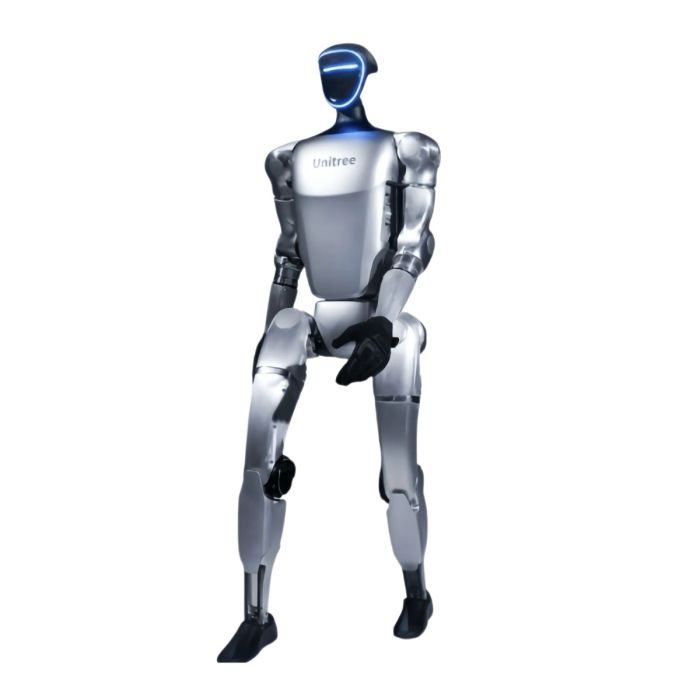
In stock
- BRAND:
- UNITREE ROBOTICS
- MODEL:
- G1 EDU PLUS
- PART #:
- G1EDU-U2
- ORIGIN:
- China
- Warranty:
- 18 MONTHS
- AVAILABILITY:
- SUBJECT TO AVAILABILITY
- SKU:
- Unitree-G1-Edu-Plus
Unitree G1 Edu Plus Humanoid Robot with Fake Hands (G1EDU-U2)
Watch a person pick a box off the floor and count what actually moves: the knees, yes — but the work lives in the torso, bending, twisting and leaning the whole upper body into the task. A humanoid with a rigid spine must fake all of that with leg squats and arm stretches, and its usable workspace shrinks to a polite bubble in front of its chest. The Unitree G1 EDU U2 — the EDU Plus configuration of the world's most widely adopted research humanoid — is the trim where the spine joins the team. Over the Standard configuration beneath it, the U2's defining upgrade is a three-axis waist: pitch, roll and yaw articulation that lets the 1.27-metre platform bend toward the floor, lean into a reach and rotate its torso through work, expanding the reachable volume from a bubble into something honestly human-shaped. Wrist articulation on the included dummy hands extends the same philosophy to the arm's end — orientation control where tasks actually demand it — and the mechanical structure is specifically reinforced to carry Unitree's Dex3-1 force-controlled fingers as a later upgrade, making the U2 the trim engineered to grow hands well. Around the new joints stands the full G1 EDU research stack: 28-29 total degrees of freedom on joints delivering up to 120 newton-metres, an NVIDIA Jetson Orin NX computing at 100 TOPS for onboard AI, 360-degree spatial perception from a Livox MID-360 3D LiDAR paired with an Intel RealSense D435i depth camera, a four-microphone array and stereo speaker, Wi-Fi 6 and Bluetooth 5.2, roughly two hours per swap-ready battery — and complete secondary development, the open platform access that is the EDU tier's reason to exist, now extended by firmware-generation updates bringing natural-language task commanding to the EDU line.
The Unitree G1 EDU U2 is available for purchase internationally through this page, with delivery, customs clearance and after-sales support arranged for buyers across Europe, the Americas, the Middle East, Asia-Pacific and worldwide.
Background
The G1: the research humanoid the field standardised on
When Unitree launched the G1, it did to full-scale humanoid research what the company had already done to quadrupeds: made the reference platform affordable enough to be everywhere. The result is the closest thing the field has to a standard — G1s populate university labs, corporate R&D floors and benchmark papers worldwide, which means a G1 buyer inherits an ecosystem no rival platform matches: community code, published controllers, simulation assets, tutorials and a hiring pool that already knows the machine. The EDU tier is where that inheritance becomes usable, opening high- and low-level interfaces the consumer trims seal, and its configuration ladder — Standard, Plus, and the Ultimate configurations above — lets institutions buy exactly the hardware their research questions require. The U2's rung is the one most manipulation-curious programmes land on: everything the Standard offers, plus the body geometry that manipulation actually needs.
Why the waist is the headline
Degrees of freedom are not equal, and the three the U2 adds at the waist are worth more than their count. Kinematically, torso articulation multiplies the workspace of both arms at once — every reachable point gains new approach angles, floor-level and above-shoulder targets enter range, and dual-arm tasks gain the coordination plane rigid-spine machines lack. Dynamically, an active waist is a balance instrument: torso lean and counter-rotation are how humans stabilise reaches and carries, and whole-body control research needs the hardware to study them. Practically, it is the difference between a robot that demonstrates in open space and one that works in real geometry — between shelves, over benches, into bins. The wrists compound the gain: orientation at the hand is what turns an arm position into a grasp pose. The U2 packages precisely the articulation that separates locomotion platforms from manipulation platforms — before a single dexterous finger is purchased.
Technical Specifications
| Parameter | Unitree G1 EDU U2 (EDU Plus) |
|---|---|
| Type | research configuration of the Unitree G1 humanoid — the EDU Plus trim |
| Height / weight | 1,270 × 450 × 200 mm standing; folds to 690 × 450 × 300 mm; ~35 kg class with battery |
| Degrees of freedom | 28-29 total — including 3-DOF waist (pitch, roll, yaw) and wrist articulation |
| Waist range | Z-axis ±155° (platform figure) |
| Joint performance | up to 120 N·m maximum torque; knee 0–165°, hip P ±154° / R −30–170° / Y ±158° |
| Hands | dummy hands with articulated wrists; structure reinforced for Dex3-1 force-controlled finger upgrade |
| Speed | up to 2 m/s |
| Compute | NVIDIA Jetson Orin NX 16 GB — 100 TOPS |
| Perception | Livox MID-360 3D LiDAR (360° mapping) + Intel RealSense D435i depth camera |
| Audio / interaction | 4-microphone array, 5 W stereo speaker, voice functionality; LLM-based natural-language task commanding on current EDU firmware |
| Development | full secondary development — high- and low-level interfaces, simulation support |
| Connectivity | Wi-Fi 6, Bluetooth 5.2 |
| Battery | ~2 h endurance; quick-swap 13-series lithium pack |
| Trim position | above U1 EDU Standard (23 DOF, 1-DOF waist); below the dexterous-hand Ultimate configurations |
Configuration contents and current firmware capabilities are confirmed against Unitree's datasheet at quotation.
U1 or U2 — where does the extra articulation pay?
Draw the line at what the robot must touch. The U1 Standard, with its 23 degrees of freedom and single-axis waist, is a complete platform for the locomotion half of humanoid research — gait learning, balance, navigation, perception — and programmes living there spend wisely at its rung. The U2 pays for itself the moment tasks involve objects at realistic heights and angles: bin picking that requires bending, shelf work requiring torso rotation, bimanual coordination requiring a mobile trunk, any whole-body-control research where the spine is a subject rather than a constraint. It is also the honest rung for programmes planning manipulation: buying the Standard and discovering mid-grant that the waist and wrists are missing means a platform swap, while the U2's reinforced Dex3-1-ready structure makes hands a bolt-on decision rather than a repurchase. The arithmetic most labs run: the Plus premium is small against the platform cost, and the articulation it buys is the exact hardware the field's current research frontier — whole-body loco-manipulation — is defined by.
Who is the Unitree G1 EDU U2 for?
For university laboratories buying their primary humanoid, where the U2's articulation keeps every thesis direction open on the field's best-supported platform; for whole-body-control and loco-manipulation researchers, to whom the three-axis waist is the experiment; for manipulation programmes staging their investment — dummy-hands-with-wrists now, Dex3-1 fingers when the research arrives — on a structure built for the upgrade; for embodied-AI groups running perception and language-commanded task stacks on the Orin NX with LiDAR-plus-depth sensing; for institutions already fleeted with R1s, for whom the G1 U2 is the natural full-scale graduation machine on familiar tooling; and for integrators developing against the installed base the G1 defines. Locomotion-only programmes save honestly at the U1; hand-equipped research from day one starts at the Ultimate configurations above.
What is the Unitree G1 EDU U2 used for?
- Whole-body control research: torso-inclusive balance, reaching and coordination studies on the 3-DOF waist.
- Manipulation-ready development: workspace, approach and bimanual research ahead of dexterous-hand upgrades.
- Perception and navigation: 360-degree LiDAR mapping and depth vision on 100 TOPS of onboard compute.
- Embodied-AI deployment: learned policies and language-commanded task execution at the edge.
- University teaching and theses: full-scale humanoid coursework on the field's standard platform.
- Benchmark and software development: building against the G1's unmatched installed research base.
Pricing and Availability
The Unitree G1 EDU U2 is available for purchase and international delivery through this page, from single laboratory units to institutional programmes, with the U1 Standard quoted where locomotion-focused fleets fit better, the Ultimate configurations where dexterous hands lead, and Dex3-1 upgrades, spare batteries and accessories provisioned to requirement. Price and cost depend on configuration, accessories, training scope and quantity, so buyers should request a current quotation; delivery, customs clearance and after-sales support are arranged worldwide. Purchase enquiries, datasheets and availability details for the G1 EDU U2 are available on this page.
Frequently Asked Questions
What is the Unitree G1 EDU U2?
The EDU Plus configuration of Unitree's G1 research humanoid — a 1.27-metre open platform distinguished by its three-axis waist and wrist articulation within 28-29 degrees of freedom, with Orin NX 100 TOPS compute, LiDAR-plus-depth perception and full secondary development.
What does it add over the G1 EDU Standard (U1)?
Articulation where manipulation needs it: the Standard's single-axis waist becomes a full pitch-roll-yaw torso, wrists articulate on the included dummy hands, and the structure is reinforced for Dex3-1 finger upgrades — the geometry that turns a walking platform into a working one.
Can it be upgraded with real dexterous hands?
Yes — that is part of the U2's engineering brief: Unitree's Dex3-1 force-controlled fingers fit as an add-on, and the Plus trim's reinforced mechanical structure is specified to carry them better than the base configurations.
How does it perceive its environment?
Through a Livox MID-360 3D LiDAR delivering 360-degree spatial mapping and an Intel RealSense D435i depth camera for close-range depth — fused on the onboard Jetson Orin NX at 100 TOPS for autonomous navigation and perception research.
Is it fully programmable?
Completely — the EDU tier opens high- and low-level development interfaces with simulation support, and current EDU firmware generations add LLM-based natural-language task commanding on top of the open stack.
How practical is it in a lab day-to-day?
Deliberately so: the platform folds to carry-size for transport, swaps its battery around a roughly two-hour endurance, and speaks and listens through its microphone array and speaker — on the humanoid with the field's largest community of code, documentation and shared experience.
Where can I buy the Unitree G1 EDU U2 and what does it cost?
The G1 EDU U2 is available through this page, with delivery, customs clearance and after-sales support arranged for buyers worldwide. Because cost varies with configuration, hand upgrades, accessories and quantity, buyers should request an individual quotation. All purchasing details are available on this page.
Summary
The Unitree G1 EDU U2 is the trim that gives the field's standard humanoid a spine worth studying: three axes of waist, wrists that orient, and a frame pre-reinforced for the fingers that come next — mounted on the open, LiDAR-sighted, 100-TOPS platform that more laboratories run than any other. It is the configuration where the G1 stops being a walker with arms and becomes a body — the hardware the loco-manipulation era is actually written on — at the rung where most serious programmes rightly land. Below it, the Standard walks; above it, the Ultimates grasp; the U2 is where the research bends to reach the world. For the labs building on it, this page is the starting point.
Specifications
General
Physical
Mobility
Performance
Computing
Sensors
Connectivity
Software
Battery + Power
Shipping
Feature
| Equipped with all the functions of G1-Edu standard version |
| Upgraded from 1 to 3 degrees of freedom in the waist. |
| Single arm freedom upgraded from 5 to 7, both arms upgraded. |
| Up to 29 DOF for whole robot |
What's included
Unitree Unitree G1 Edu Plus
Dummy Hands
Quick Release Smart Battery
Battery Charger
Handheld Remote Control