
LimX Tron 1 Education Edition Multi-Modal Biped Robot
In stock
- BRAND:
- LIMX
- MODEL:
- TRON 1 EDUCATION EDITION
- ORIGIN:
- China
- AVAILABILITY:
- SUBJECT TO AVAILABILITY
- SKU:
- LimX-Tron-1-Edu
LimX Tron 1 Education Edition Multi-Modal Biped Robot
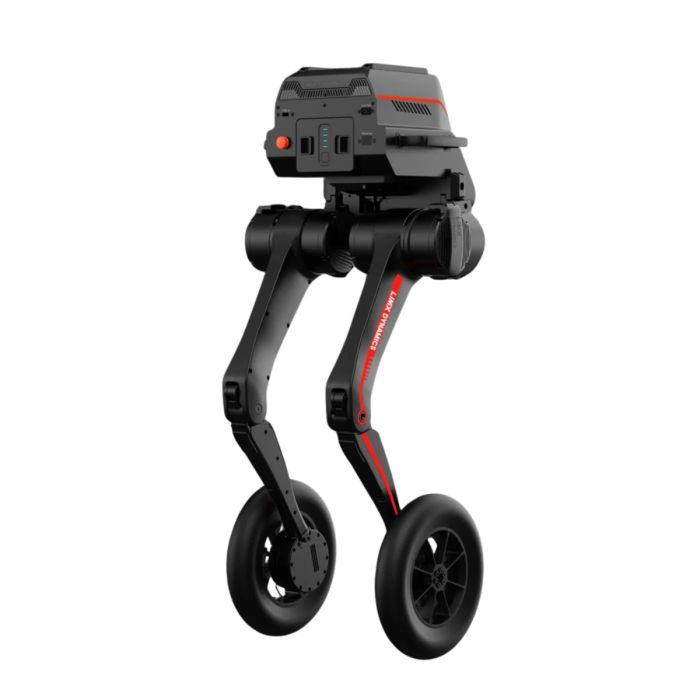
TRON 1’s signature concept is its modular foot-end system, which allows users to switch between multiple locomotion modes—commonly described as point-foot, sole-foot, and wheeled configurations—supporting experiments that compare gait stability, control strategies, and terrain adaptation within a single robot platform.
The Education Edition is distinguished by its open SDK and support for secondary development, enabling deeper access to hardware and software interfaces for research-grade customization. LimX explicitly notes that the Standard Edition does not support secondary development, making the EDU model the preferred option for institutions and developers building custom autonomy stacks and control pipelines.
Design and Features
Multi-modal modular foot-end architecture
TRON 1 EDU is built around a three-in-one modular design intended for multi-modal algorithm development. This approach allows researchers to keep the same core robot body while modifying the contact mechanics and mobility behavior via interchangeable foot modules.
Commonly referenced locomotion modes include:
-
Point-foot mode (legged, dynamic balance emphasis)
-
Sole-foot mode (larger contact area, stability emphasis)
-
Wheeled mode (higher speed and efficiency on smooth surfaces)
This modularity makes TRON 1 EDU useful in coursework and lab work that compares control policies across different contact models, including ZMP-style stabilization, model-predictive control, and reinforcement learning-based gait strategies.
Education Edition with open SDK
LimX markets TRON 1 EDU as the “first multi-modal biped robot with fully open SDK”, emphasizing:
-
an accessible development environment,
-
support for fast algorithm validation,
-
and expansion ports for research peripherals.
Because multi-modal mobility experiments often require custom sensors and compute add-ons, this open-development orientation is central to TRON 1 EDU’s role as an educational and research platform rather than a closed demonstration robot.
Compact, lab-friendly industrial design
TRON 1 EDU is compact enough for labs and classrooms while retaining materials consistent with engineering prototypes. LimX lists the chassis materials as aluminum alloy and industrial plastic, balancing weight, strength, and ease of handling during transport and setup.
Technology and Specifications
Note: Public specifications may vary slightly across listings and revisions. The details below reflect the most widely published manufacturer specifications and common reseller summaries.
Mechanical parameters
LimX lists the following core physical specifications for TRON 1:
-
Dimensions: ≤ 392 mm × 420 mm × 845 mm
-
Net weight: ≤ 20 kg
-
Materials: Aluminum alloy + industrial plastic
This footprint places TRON 1 EDU in a category that is often easier to deploy than full-size humanoids, while remaining large enough for meaningful locomotion experiments (including stairs and obstacle traversal in controlled settings).
Battery and power system
TRON 1 EDU uses a battery system designed for lab iteration and rapid turnaround:
-
Battery supply voltage: 46.8 V
-
Maximum battery power: 1,000 W
-
Battery capacity: 4.5 Ah
-
Battery range: up to ~2 hours
-
Charging time: <1 hour (20%–80%), ~1.5 hours (100%)
-
Battery swapping: supported (quick swap workflow)
Battery swapping is particularly valuable in education and research, where repeated short experiments are common and minimizing downtime can accelerate iteration.
Mobility performance
LimX specifies multi-modal speed limits depending on foot configuration:
-
Point-foot speed: < 1 m/s
-
Sole-foot speed: < 1 m/s
-
Wheeled speed: up to 3 m/s
For terrain capability, the manufacturer lists:
-
Maximum climbing angle: ≤ 30°
-
Maximum obstacle height limitation: ≤ 20 cm
Some third-party summaries cite more conservative limits (for example, ~15° climb and ~15 cm obstacle height) depending on configuration and interpretation, which can reflect safety margins, mode-specific constraints, or different revisions.
Payload capacity
LimX lists a load capacity ≤ 10 kg, making TRON 1 EDU relevant for experiments involving carried sensors, accessory compute modules, or light payload transport in wheeled mode.
Some reseller descriptions reference higher peak values (e.g., “maximum 15 kg”), which are typically best treated as context-dependent or momentary limits rather than sustained operating capacity.
Compute and interfaces
LimX lists an onboard computer configuration of:
-
12th Gen Intel i3 / 16 GB RAM / 512 GB storage
For expansion and integration:
-
USB 3.0 × 1
-
Gigabit Ethernet (GbE) × 1
-
Peripheral power: 24 V, 100 W output (200 W peak)
These ports support typical robotics workflows such as adding:
-
RGB/RGB-D cameras,
-
LiDAR modules,
-
external compute,
-
or communication bridges for fleet and teleoperation.
Sensors and remote control
Manufacturer-listed sensing and operation elements include:
-
IMU: supported
-
Handheld remote controller: included
-
Remote communication range: 50 m
-
Remote E-stop: supported
TRON 1 EDU is typically used in indoor lab settings, and LimX lists an operating environment range of:
-
-5°C to 40°C (favorable weather conditions)
Applications and Use Cases
Robotics education and teaching laboratories
TRON 1 Education Edition is often used to teach:
-
biped dynamics and balance control,
-
state estimation (IMU-driven stabilization),
-
gait generation and tuning,
-
and real-world validation of simulation results.
Its multi-modal nature makes it particularly suitable for curricula comparing locomotion strategies across contact conditions (point-feet vs soles vs wheels).
Locomotion R&D and algorithm benchmarking
TRON 1’s interchangeable foot modules are widely described as enabling controlled testing of different motion control systems. A commonly cited advantage is that researchers can compare algorithms under the same hardware constraints without switching robot models.
Embodied intelligence and reinforcement learning workflows
LimX positions TRON 1 EDU as a “gateway” to humanoid and embodied RL research, reflecting the broader industry shift toward training locomotion policies using:
-
imitation learning,
-
reinforcement learning,
-
and hybrid model-based + learned control stacks.
Prototyping and competitions
Because it is designed to be “ready to use” and easy to start, TRON 1 EDU is also used for prototyping demonstrations in university settings and robotics challenges that emphasize mobility, autonomy, and control robustness.
Advantages / Benefits
One robot, multiple mobility modes
A primary benefit is multi-modal reconfiguration—users can explore legged balance and wheeled efficiency within a single platform.
Research-friendly development access
The open SDK and secondary development support make the Education Edition better suited for advanced robotics work than non-developer-focused versions.
Fast deployment and iteration
Features like quick battery swapping, straightforward remote operation, and standard expansion ports reduce setup friction, which is especially important in classroom and lab environments.
FAQ
What is LimX TRON 1 Education Edition?
LimX TRON 1 Education Edition is a multi-modal biped robot with an open SDK, designed for robotics education and research in locomotion, balance control, and embodied intelligence.
How does LimX TRON 1 Education Edition work?
TRON 1 EDU works through a modular foot-end system that supports multiple mobility modes (including point-foot, sole-foot, and wheeled operation), combined with onboard compute and sensor feedback for stabilization and motion control development.
Why is LimX TRON 1 Education Edition important?
It is important because it provides a relatively compact, configurable platform for real-world legged robotics experiments, enabling students and researchers to validate algorithms across multiple locomotion modes using one robot system.
What are the benefits of LimX TRON 1 Education Edition?
Key benefits include open SDK access, multi-modal locomotion experimentation, quick deployment features like battery swapping, and standard connectivity options (USB and Ethernet) for sensor and compute expansion.
Summary
The LimX TRON 1 Education Edition is a multi-modal biped robot designed for education and research, combining a compact form factor with a modular foot-end architecture and an open SDK for advanced development. By supporting multiple locomotion modes (including wheeled mobility) and providing practical expansion interfaces, TRON 1 EDU serves as a flexible platform for biped control, gait experimentation, and embodied AI validation in modern robotics labs.