
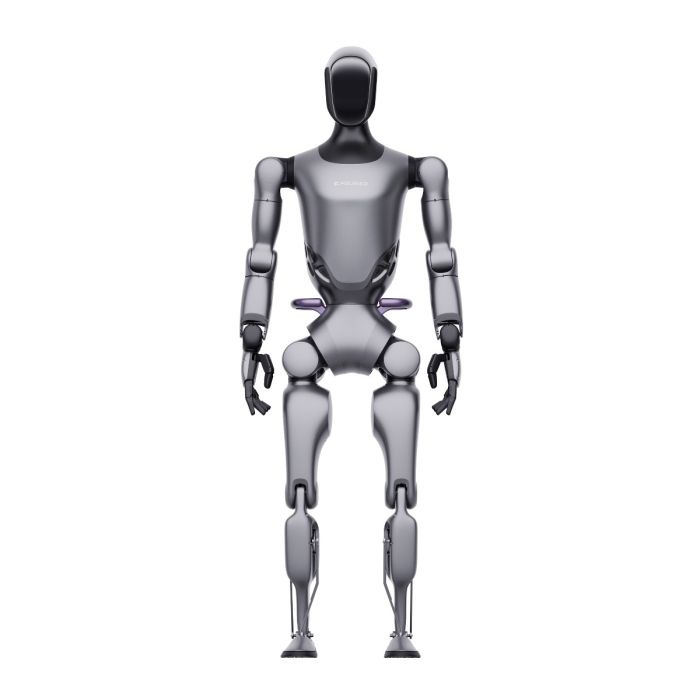
Fourier GR2 Humanoid Robot + Free Shipping
The GR-2 is designed to bridge the gap between laboratory humanoid robotics and practical applications. Its human-scale form factor, higher degree of freedom count, improved hand manipulation, longer runtime, and support for modern robotics frameworks make it relevant to teams working on embodied AI, teleoperation, perception, locomotion, and service robotics.
Design and Features
Human-Scale Humanoid Architecture
Fourier lists the GR-2 at 175 cm tall and about 63 kg, placing it within a human-like size range suitable for interaction in environments designed around human proportions. The robot uses a body structure with up to 53 actuators / degrees of freedom, allowing it to simulate a broad set of human motions including walking, grasping, torso movement, and recovery behaviors such as getting up from the ground.
Integrated Cabling and Modular Engineering
A major design change in the GR-2 is its integrated cabling layout, which conceals wires and improves packaging efficiency. Fourier also says the robot’s joint configuration was redesigned from a more parallel structure toward a serial structure to simplify control, reduce maintenance burden, and improve the robot’s transition from simulation environments into real-world operation. This matters for developers because mechanical layout and serviceability directly affect iteration speed and reliability.
12-DoF Dexterous Hands
One of the GR-2’s standout features is its 12-degree-of-freedom dexterous hands, which Fourier describes as doubling the dexterity of earlier models. The hands are equipped with six array-type tactile sensors, allowing the robot to sense force, estimate object characteristics, and adjust grip in real time. In practical terms, this improves the robot’s ability to handle objects more delicately and perform manipulation tasks in dynamic settings.
Teleoperation and Teaching Modes
GR-2 supports multiple upper-limb teaching and control methods, including VR remote control, lead-through programming, and direct command. Fourier positions these capabilities as valuable for data collection, imitation learning, task demonstration, and faster development of real-world workflows.
Technology and Specifications
Core Mechanical and Performance Specifications
According to Fourier’s published materials, the GR-2 includes the following headline specifications: 1750 mm × 552 mm × 275 mm dimensions, approximately 63 kg weight, up to 53 actuators, maximum walking speed of 5 km/h, and single-hand payload of about 3 kg. Fourier also lists an arm reach of 1520 mm, extending to up to 1920 mm with the 12-DoF dexterous hand version.
Actuation and Motion Control
The robot uses Fourier’s FSA 2.0 actuator architecture, with published materials citing peak torque above 380 N·m, while newer support documentation lists maximum joint peak torque of 436 N·m. The system also uses dual encoders, which Fourier says improve control precision. Taken together, these details suggest that the GR-2 is designed not only for slow demonstration tasks but also for more dynamic whole-body movement and stable manipulation.
Compute, OS, and Developer Stack
Fourier states that the GR-2 runs Ubuntu 20.04 and includes a 14-core Intel Core i7 base computing platform, with an optional higher-performance compute module. For development, the platform supports NVIDIA Isaac Lab, ROS, and MuJoCo, and Fourier’s toolkit exposes pre-optimized modules through APIs. This makes the GR-2 appealing for universities, robotics labs, and companies building embodied AI workflows that require simulation, teleoperation, and deployment on physical hardware.
Sensors, Interfaces, and Connectivity
Published documentation lists a stereo or binocular camera system, a 6-axis IMU, Ethernet, and Wi-Fi 6 connectivity. Fourier also notes support for vision-based perception and SLAM-related workflows in its GR-2 materials. These features are important because humanoid robots rely heavily on perception, pose estimation, scene understanding, and low-latency communication for safe and useful operation.
Battery and Runtime
The GR-2 uses a detachable lithium-ion battery of roughly 950 Wh, with an average runtime of about 2 hours and a charging time of about 2 hours. Fourier’s launch announcement said the battery capacity was doubled relative to the previous generation, extending runtime by about an hour. That combination of swappable power and moderate operating endurance makes the system more practical for demos, research sessions, and pilot workflows than earlier short-duration humanoid platforms.
Applications and Use Cases
The Fourier GR-2 is best understood as a developer-ready humanoid robot platform rather than a single-purpose appliance. Fourier explicitly highlights use cases across research and education, reception services, manufacturing, and rehabilitation or nursing-related services.
In research settings, the robot is relevant for embodied AI, humanoid locomotion, robot grasping, teleoperation, human-robot interaction, and simulation-to-real transfer. In commercial and institutional settings, it may be used for pilot projects involving guided interaction, light material handling, demonstrations, and service scenarios where human-like reach and form factor are useful. Its tactile sensing, developer APIs, and framework compatibility also make it attractive for laboratories training multimodal policies and manipulation models.
Advantages / Benefits
The main advantages of the GR-2 are its human-scale body, high dexterity, strong developer tooling, and open integration approach. Compared with many humanoid announcements that emphasize concept videos more than deployment details, Fourier provides unusually concrete documentation around battery system, interfaces, compute environment, teleoperation methods, and supported software frameworks.
Another benefit is the balance between mobility and manipulation. A 5 km/h walking speed, 53-DoF architecture, tactile-sensing dexterous hands, and a moderate payload rating suggest a machine suited to experimentation across multiple robotic domains rather than a platform optimized only for one narrow benchmark.
FAQ Section
What is the Fourier GR-2 humanoid robot?
The Fourier GR-2 is a general-purpose humanoid robot developed by Fourier. It features a human-scale body, up to 53 degrees of freedom, dexterous hands with tactile sensing, and a developer-oriented software platform for research and real-world robotics applications.
How does the Fourier GR-2 work?
The GR-2 combines actuators, encoders, cameras, an IMU, onboard computing, and developer software to perform walking, grasping, teleoperation, and task-learning workflows. It also supports VR control, lead-through programming, and frameworks such as ROS, NVIDIA Isaac Lab, and MuJoCo.
Why is the Fourier GR-2 important?
The GR-2 is important because it represents a more deployment-ready humanoid platform with stronger manipulation, clearer developer tools, and better simulation-to-real support than many earlier humanoid systems. It is aimed at making embodied AI and humanoid robotics more accessible to labs and organizations.
What are the benefits of the Fourier GR-2?
Key benefits include human-like size, 12-DoF dexterous hands, tactile sensing, 53-DoF body architecture, a detachable battery, support for modern robotics frameworks, and a platform designed for research, teleoperation, and embodied AI development.
What is the runtime of the Fourier GR-2?
Fourier lists the GR-2 with an average runtime of approximately 2 hours, using a detachable lithium-ion battery system.
What is the payload capacity of the Fourier GR-2?
Published materials list a single-hand or single-arm payload capacity of about 3 kg, depending on the document wording.
Summary
The Fourier GR-2 Humanoid Robot is a modern, developer-focused humanoid platform that combines 53 DoF motion, 12-DoF tactile-sensing hands, 2-hour detachable battery runtime, and support for ROS, MuJoCo, and NVIDIA Isaac Lab into a single embodied AI system. For research institutions, robotics developers, and organizations exploring advanced humanoid automation, the GR-2 stands out as a credible and well-documented platform. The “free shipping” element may apply on selected listings, but the robot’s real value lies in its hardware maturity, software openness, and practical suitability for next-generation humanoid robotics.