
Fourier GR-3 Care-Bot Humanoid Robot
In stock
- BRAND:
- FOURIER
- PART #:
- GR-3
- ORIGIN:
- China
- AVAILABILITY:
- SUBJECT TO AVAILABILITY
- SKU:
- Fourier-GR-3
Fourier GR-3 Care-Bot Humanoid Robot + Free Shipping
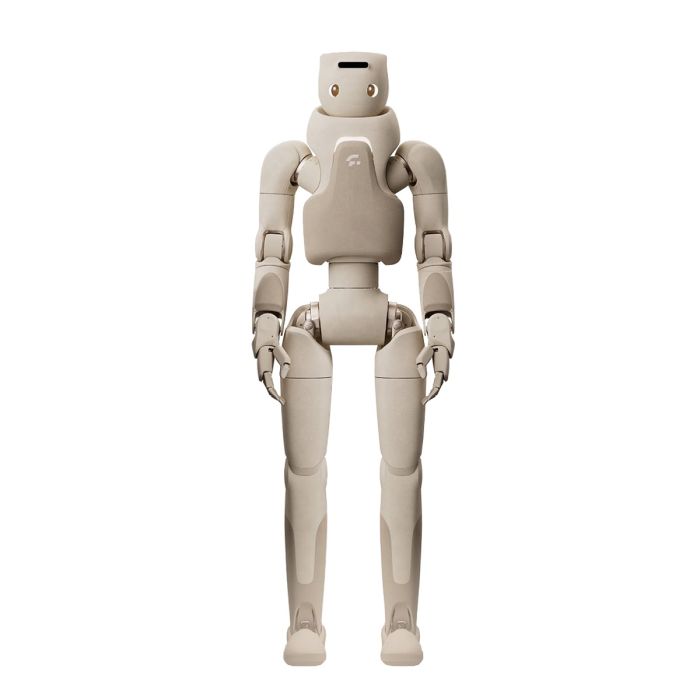
Fourier GR-3 is a care-centric, full-size humanoid robot developed by Fourier Robotics (also known as Fourier Intelligence). The GR-3 is positioned as the company’s first “Care-bot,” designed not only for functional tasks but also for emotional interaction and social companionship in homes, public venues, education, and clinical settings. The company frames GR-3 as the latest entry in its GRx series, blending soft aesthetics with multimodal perception and lifelike whole-body motion.
On Fourier’s official product page, the GR-3 is described as a “caring and capable companion” with a warm, approachable exterior, animated facial interface, and compact, modular architecture intended for daily human interaction. The page highlights a multisensor “Full-Perception Multimodal Interaction System” that unifies vision, audio, and touch into a real-time emotional engine.
Design and Features
Soft design, human-centered form
GR-3 departs from industrial aesthetics, adopting cushioned surfaces, neutral tones, and automotive-grade upholstery to reinforce comfort and trust. It features expressive micro-behaviors (eye tracking, blinking, emotion-triggered gestures) and a facial display to support natural social cues.
Multimodal interaction
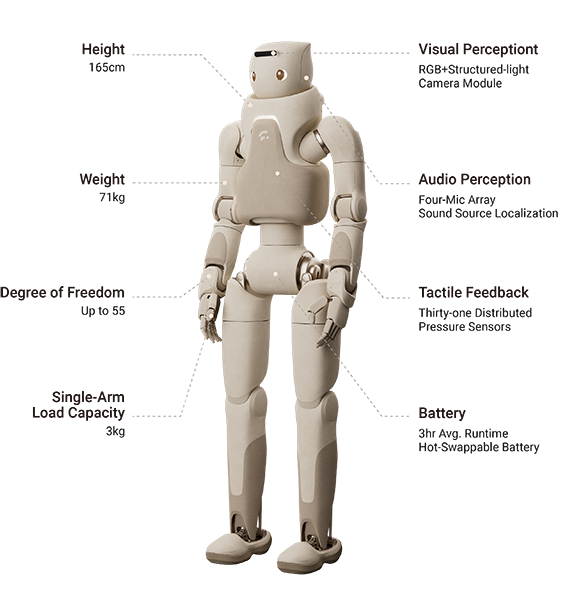
The robot integrates tactile feedback, sound-source localization, and visual recognition to respond to users in real time. Notably, the platform uses a four-microphone array for far-field voice activation and a RGB + structured-light camera module for facial recognition and dynamic target tracking. Thirty-one distributed pressure sensors in the shell enable nuanced touch responses.
Character-rich locomotion
Beyond core gait stability, GR-3 can vary its movement style—switching among straight-leg gait, running, an energy-saving “fatigue mode,” and a more animated “bouncy walk.” The intent is to make motion context-appropriate and emotionally legible while preserving safety.
Dexterous hands and modular internals
Fourier cites 12-DoF dexterous hands, high-performance actuators, and a hot-swappable battery system for continuous operation. The internal layout clusters sensors and compute into modules behind a streamlined exterior, aiming for serviceability and future upgrades.
Technology and Specifications
Headline specs
Published figures across Fourier materials list:
-
Height: 165 cm (full-size humanoid)
-
Joints / DoF: up to 55
-
Operating time: ~3 hours per pack (hot-swappable for extended duty)
-
Mass: 71 kg
Perception & HRI stack
-
Audio: 4-mic array with echo cancellation and omnidirectional wake/beamforming; the robot orients toward speakers with synchronized eye contact.
-
Vision: RGB + structured-light module for facial recognition and dynamic tracking in close social ranges.
-
Touch: 31 pressure sensors enabling full-body touch detection and graded responses (micro-expressions, gaze shifts, gesture adjustments).
Cognitive architecture
Fourier describes a dual-path response: fast reflexive behaviors for immediate cues (e.g., turning when called) and contextual dialogue & decision-making mediated by large-model reasoning for nuanced interactions. An attention management system prioritizes inputs and synchronizes outputs to maintain smooth, human-like responses.
Motion & manipulation
GR-3 employs redesigned whole-body structure and actuators for greater flexibility relative to earlier GRx models, with bending and squatting support and lifelike upper-body gestures. The 12-DoF hands target safe handling of common objects in public and domestic spaces.
Independent media coverage following the reveal emphasized the robot’s “care” positioning and soft-touch exterior, underlining Fourier’s pivot toward emotionally literate HRI for homes, classrooms, and clinical environments.
Applications and Use Cases
Companionship and public interaction
Fourier positions the GR-3 as a social companion for public settings—engaging visitors, offering guidance, and providing interactive entertainment or comfort to children and older adults. The multimodal stack supports face-to-face presence, name/face recall, and contextual responses that make lightweight engagements feel personal.
Assisted living & future care
The company envisions expansions into assistive care, including mobility support, basic health monitoring, and rehabilitation/clinical routines where appropriate. While these pathways are forward-looking, the hot-swappable battery and whole-body compliance are aligned with continuous operation alongside people.
Education and research
With a developer-oriented software platform and planned interaction APIs, GR-3 is aimed at HRI research, robotics curricula, and AI application prototyping, enabling teams to explore affective interaction, safety in close contact, and multi-sensor fusion under real-world constraints.
Hospitality and service scenarios
Market watchers have framed GR-3 as suitable for front-of-house engagement and light assistance in hotels, malls, and campuses—situations where approachability and predictable social behavior are as important as manipulation strength.
Advantages / Benefits
-
Human-centered design: Soft shell, micro-expressive face, and character-rich locomotion reduce social friction and support trust-building in shared spaces.
-
Rich multimodality: Unified vision-audio-tactile pipeline with attention management improves turn-taking, gaze behavior, and touch responses versus single-modality companions.
-
Continuous operation: Hot-swappable power enables long duty cycles in receptions, classrooms, or clinics.
-
Developer focus: An embodied-intelligence platform with planned APIs lowers integration barriers for HRI studies and custom apps.
Comparisons
Within humanoids, GR-3 prioritizes affective interaction over heavy industrial payloads:
-
Versus general-purpose, factory-oriented humanoids: Those emphasize torque, endurance, and manipulation under load; GR-3 optimizes approachability, safety, and expressive motion in social environments. (Synthesis of category differences; see Fourier’s “Care-bot” framing.)
-
Versus prior Fourier GR-1/GR-2 models: GR-3 is described as more compact with enhanced HRI, redesigned whole-body structure, and more lifelike locomotion and touch interaction, reflecting a shift from general demonstrations to daily companionship.
FAQ Section
What is the Fourier GR-3?
GR-3 is a care-centric humanoid robot in Fourier’s GRx series, designed for emotional interaction, social companionship, and human-centered services in public and private spaces. It debuted on August 6, 2025.
How does GR-3 work?
It combines multimodal perception (vision, audio, touch) with a dual-path response architecture—fast reflexes for immediate cues and large-model reasoning for contextual dialogue—coordinated by an attention management layer for smooth, humanlike behavior.
Why is GR-3 important?
GR-3 reframes humanoid value around acceptance and care, prioritizing soft design, lifelike motion, and tactile/voice/vision fusion to enable safe, natural interaction in homes, classrooms, clinics, and public venues.
What are the headline specs?
Published materials list 165 cm height, up to 55 DoF, and about 3 hours per battery (hot-swappable).
Is GR-3 suitable for heavy industrial tasks?
No. GR-3’s strengths are HRI and companionship. For payload-heavy or high-throughput tasks, industrial robots or different humanoid classes are more appropriate. (Category guidance based on vendor framing and media coverage.)
Summary
Fourier GR-3 advances the GRx line toward human-acceptable, emotionally aware robots. With 165 cm stature, 55-DoF motion, tactile/voice/vision fusion, and a soft-touch design, it targets companionship, education, public service, and future care applications rather than heavy industrial roles. Pricing remains inquiry-based, but the platform’s combination of attention-managed multimodality, hot-swappable power, and expressive locomotion makes GR-3 a notable entry in the emerging class of care-oriented humanoids.
Fourier GR-3 Care-Bot Humanoid Robot
The GR-3 Series marks Fourier' s third generation in humanoid robotics. Guided by the philosophy "Love, above all functionality," GR-3 redefines how humans interact with robots. The series combines a powerful technical foundation with a presence that feels more human. The lineup features GR-3 for interactive service and GR-3C for functional performance.
GR-3 "Meow-bot"
GR-3 is Fourier' s first full-size "Care-bot" designed for wellness companionship. Beyond functionality, it is designed to foster emotional connection - introducing a new class of Al robots for human-centered scenarios.
GR-3C "Cosmo"
GR-3C builds on the standard model with an LED ring-head display and reinforced shell, supporting precise operation in complex environments. Its all-white finish and head design evoke an "astronaut" look, while the durable, easy-to-maintain outer shell ensures long-term reliability.
Groundbreaking Concept Innovation
Fourier has long been guided by a human-centered approach, designing robots to serve people first. Beyond pure functionality, we add the element of companionship. Human-robot interaction should surpass a simple user-tool relationship, but be both useful and full of care.
Social Companion
GR-3 is designed to engage with people in public settings. It can act as a service assistant, a comforting presence for children, or a responsive companion for the seniors.
Assistive Companion
GR-3C is expected to expand into assistive practices. Potential applications include research, high-risk operations, and rehab training, bringing support to both work and daily life.
Solid and Robust Performance Base
The GR-3 Series builds on two generations of innovation. It features advanced motion control, whole-body teleoperation, and a modular design that integrates sensors and computing units with ease, delivering both precision and reliability for real-world tasks.
Equipped with Fourier' s high-performance actuators and multi-DoF dexterous hands, GR-3 handles complex operations with stability and accuracy. Its refined structure is lighter, more compact, and energy-efficient. Dual hot-swappable batteries keep the robot running around the clock, with faster charging and fewer swaps, ensuring uninterrupted performance.
Soft Design, Smart Technology
Beyond emotional intelligence, GR-3 features enhanced hardware and character-rich locomotion-enabling more intuitive and lifelike interactions at every touchpoint.
Drawing on training data and market feedback from its predecessors, the robots' whole-body structure has been redesigned for greater flexibility and a more compact form. It features Fourier' s high-performance actuators and multi-DoF dexterous hands, supporting a wide range of tasks from interaction and navigation to practical assistance.
Advanced Feature: Whole-Body Teleoperation
The GR-3 Series supports whole-body teleoperation, enabling real-time mapping of human movements through high-precision motion capture and low-latency transmission.
By extending human reach beyond physical limits, it delivers a new level of interaction and collaboration across diverse scenarios.
Features: Soft design with warm tones and cushioned surfaces, compact modular architecture, expressive design with animated facial interface, Full-Perception Multimodal Interaction System (vision, audio, tactile), 31 pressure sensors for tactile feedback, RGB and structured-light camera for visual recognition, four-microphone array for audio perception, versatile motion capabilities (walking, bending, squatting, running), advanced attention management system.