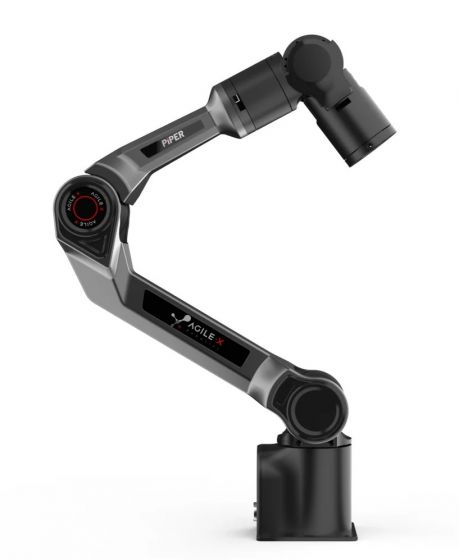
AgileX PiPER
PiPER is a lightweight robotic arm with six integrated joint motors for smooth, precise control. Weighing just 4.2kg, it easily handles a 1.5kg payload and is made from durable yet lightweight materials for versatile use across various environments. PiPER is compact powerful, supporting a stable 1.5kg payload while maintaining agility in motion. Equipped with advanced joint motors and path planning, PiPER delivers precise and smooth operation, perfect for detailed tasks. Designed to operate in extreme conditions ranging from -20℃ to 50℃, PiPER performs reliably in tough environments. Our modern tablet-based interface leverages a powerful system, enabling users to effortlessly build and control their applications. PiPER can be controlled via Python API and supports both ROS1 and ROS2, offering flexibility for developers and ensuring smooth integration across a variety of projects. Robotic Arm (PiPER)
Introduction / Overview
AgileX PiPER (often styled “PiPER”) is a compact, lightweight 6-degree-of-freedom (6-DOF) robotic arm designed primarily for education, research, and rapid prototyping in robotics and automation. The product is positioned as a developer-friendly arm that combines a small footprint with an integrated controller, a CAN-based control interface, and software support oriented toward robotics development workflows, including Python API control and ROS/ROS 2 integration.
PiPER is typically described as suitable for tasks that benefit from repeatable motion and a modest payload, including laboratory automation experiments, embedded robotics projects, and data-collection pipelines for embodied AI research. The official product listing emphasizes usability features such as a tablet-oriented interface and open-source-friendly control paths, while the official quick-start documentation frames the arm as a platform for learning and deployment across consumer-level and industrial automation scenarios.
Design and Features
PiPER’s industrial design focuses on low mass, integrated actuation, and simplified setup. AgileX’s product description highlights “six integrated joint motors” for smooth control, with materials described as an aluminum-alloy structure paired with a polymer/plastic shell, aiming to balance rigidity, portability, and everyday durability.
A key feature in the official quick-start manual is teach/demonstration (drag-teaching) functionality, where users can physically guide the arm to record a trajectory and then replay it. The manual describes indicator-light states for recording and playback and notes that each new recording overwrites the previous one, reflecting a straightforward workflow often used.
From a systems perspective, PiPER is designed to be used either as a standalone arm or as a component in larger robots (including mobile platforms). The manual explicitly describes installation compatibility “with all AgileX robotics products,” supporting the common robotics pattern of pairing a manipulator with a mobile base or fixed workstation.
Technology and Specifications
Core kinematics and performance
PiPER is specified as a 6-DOF arm with an effective payload of 1.5 kg and a working radius around 626–627 mm (listed as 626 mm on the product page and 626.75 mm in the manual). Repeatability is specified at ±0.1 mm, and the arm’s mass is listed at 4.2 kg, placing it in the lightweight research/education manipulator category.
The manual also provides joint motion ranges and maximum joint speeds for each axis (for example, J1 ±154°, J2 0°–195°, and maximum speeds reaching up to ~225°/s on several joints), while noting that values are obtained in controlled testing conditions and may vary in real use.
Power, interfaces, and control
PiPER uses a DC 24V power supply specification, with the quick-start manual listing a standard supply of DC24V (min 24V, max 26V) and power consumption figures including max power ≤120W and comprehensive power ≤40W.
For communications and control, the arm is specified to use CAN as the primary communication method. The manual describes CAN-H and CAN-L terminals on the electrical interface and a workflow using a CAN-to-USB adapter for connection to a host computer.
Software ecosystem (Python, ROS, and toolchains)
AgileX’s official PiPER product page states that the arm can be controlled via a Python API and supports ROS1 and ROS2, emphasizing smoother integration for developers working in common robotics stacks. The quick-start manual similarly describes “secondary development” via a Python SDK and ROS driver packages.
On the developer side, AgileX maintains a public ROS workspace/repository that documents installation and usage patterns, including MoveIt-related configuration guidance and CAN interface setup instructions, reflecting the expected workflow for motion planning, visualization (RViz), and integration in research pipelines.
Environmental specifications and operating context
The official product page describes an operating temperature range of -20°C to 50°C and positions the arm as suitable for “harsh environment adaptability” within that range. The manual echoes this range and additionally lists humidity guidance (25%–85% non-condensing), noise level (<60 dB), and an IP rating note (IP22 unless custom-rated), which is relevant when assessing suitability for workshop or light-industrial environments.
Applications and Use Cases
PiPER is frequently presented as a platform for education and research, particularly where teams want a compact arm that can be quickly integrated into robotics software stacks and demonstrations. The quick-start manual explicitly names education/research and includes examples such as humanoid robot arms, automatic assembly, and automated handling, while also emphasizing ease of use for non-professional users via an intuitive interface.
In practical deployments, PiPER can be used for:
-
ROS learning and laboratory prototyping, where repeatable trajectories and basic manipulation tasks are needed for coursework or experiments.
-
Embodied AI and data collection, where controlled arm motion supports dataset generation (e.g., collecting trajectories, grasps, or interaction sequences).
-
Light pick-and-place and bench automation, constrained by the 1.5 kg payload and working radius, with performance shaped by end-effector choice and mounting stability.
Advantages / Benefits
PiPER’s primary advantages are tied to accessibility, integration, and portability. With a 4.2 kg arm weight and integrated controller, it is easier to mount on benches, carts, or mobile platforms than heavier industrial arms, while still offering a published repeatability figure appropriate for many research tasks.
A second benefit is the emphasis on developer workflow alignment: AgileX promotes Python control plus ROS1/ROS2 support, and the published ROS workspace material shows practical guidance for connecting over CAN and integrating common robotics tooling (e.g., visualization and motion-planning stacks).
Finally, the inclusion of drag-teaching / trajectory recording and playback supports fast demonstrations and early-stage automation proof-of-concepts without requiring full programming from the start.
FAQ Section
What is AgileX PiPER?
AgileX PiPER is a lightweight 6-DOF robotic arm designed for education, research, and prototyping, with published specifications including a 1.5 kg payload, ~626 mm working radius, and ±0.1 mm repeatability.
How does AgileX PiPER work?
PiPER is controlled through a host system over CAN, typically using a CAN-to-USB adapter, and can be programmed via a Python SDK or integrated into ROS/ROS 2 workflows for planning and control.
Why is AgileX PiPER important?
PiPER addresses a common need in robotics: an approachable, portable manipulator that supports modern developer stacks. Its documentation and tooling emphasize secondary development (Python + ROS packages) and practical workflows like drag-teaching for fast demonstrations.
What are the benefits of AgileX PiPER?
Commonly cited benefits include a compact 4.2 kg arm mass, 6-DOF manipulation with a 1.5 kg payload, CAN-based control, and developer-oriented software paths including Python API control and ROS/ROS 2 support.
Summary
AgileX PiPER is a lightweight, developer-focused 6-DOF robotic arm aimed at robotics education, research, and rapid prototyping. With published specifications of a 1.5 kg payload, ~626 mm reach, ±0.1 mm repeatability, and CAN-based control—plus Python SDK and ROS/ROS 2 support—PiPER is commonly used as a practical platform for manipulation demos, lab automation experiments, and embodied AI data-collection workflows.