
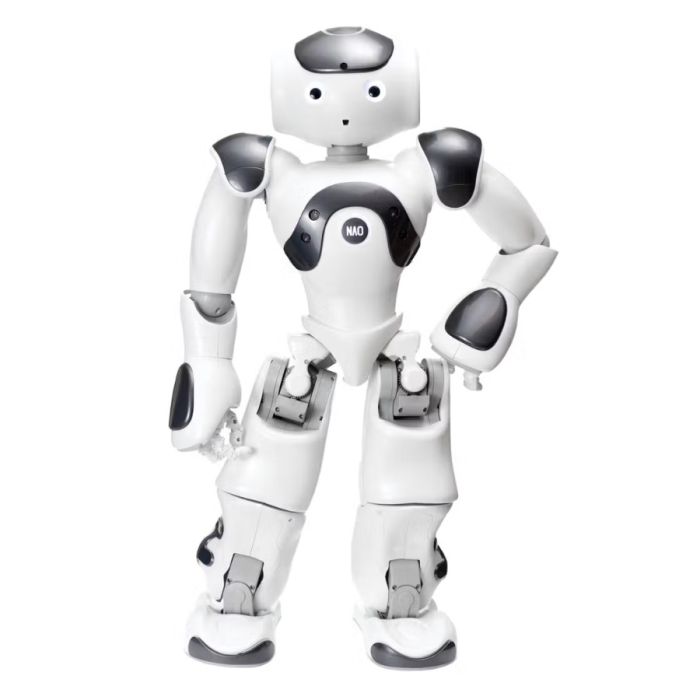
Softbank Robotics NAO V6 Humanoid Robot
In stock
- BRAND:
- SOFTBANK
- MODEL:
- NAO
- AVAILABILITY:
- SUBJECT TO AVAILABILITY
- SKU:
- SoftBank-NAO
Softbank Robotics NAO V6 Humanoid Robot
The Softbank Robotics NAO V6 Humanoid Robot is one of the most widely recognized programmable humanoid platforms in education and research. Compact, expressive, and designed to be approachable, NAO combines 25 degrees of freedom with cameras, microphones, and touch sensors, allowing it to move naturally, perceive its surroundings, recognize faces and objects, and interact with people through speech and gesture. Backed by a comprehensive software development kit, a user-friendly programming interface, and an active community of developers and educators, the V6 generation continues NAO's long-standing role as a standard platform for teaching programming and robotics, studying human-robot interaction, and developing artificial intelligence applications. This page summarizes what the platform offers, who it serves, and how to proceed with a purchase enquiry.
Background
NAO's role in education and research
NAO has become a fixture in classrooms, universities, and research laboratories because it solves a practical problem: teaching and studying robotics requires hardware that is capable enough to be interesting yet robust and safe enough to hand to students. As a small humanoid with expressive movement and multimodal sensing, NAO lets learners see abstract programming concepts embodied in physical behaviour — a loop becomes a repeated gesture, a conditional becomes a decision to speak or move. In research settings, the platform's standardized hardware and software have made it a common baseline for human-robot interaction studies, allowing results to be compared and reproduced across institutions. Its use has extended into special education contexts as well, where educators have employed NAO as an engaging, patient interaction partner in structured programmes for children with autism spectrum disorder; outcomes in such settings depend on professional protocols and qualified supervision, and the robot is a tool within those programmes rather than a therapy in itself.
The platform and its ecosystem
A large part of NAO's value lies outside the robot's shell. SoftBank Robotics ships the platform with a comprehensive software development kit and a user-friendly programming interface, which together support users from first-time programmers working in visual environments through to graduate researchers writing custom perception and behaviour code. Around that tooling has grown a vibrant community of developers and educators who share resources, publish curricula, and build new applications for the platform. For institutions, this ecosystem matters as much as the hardware: lesson plans, example projects, and peer support reduce the time from unboxing to productive classroom or laboratory use, and community-contributed work extends the robot's capabilities well beyond its factory behaviours.
Technical Specifications
| Parameter | Value |
|---|---|
| Type | Programmable humanoid robot |
| Generation | NAO V6 |
| Degrees of freedom | 25 |
| Vision | Cameras for environment perception and face/object recognition |
| Audio | Microphones supporting spoken interaction |
| Touch | Touch sensors for physical interaction |
| Software | Comprehensive SDK with user-friendly programming interface |
| Primary domains | Education, research, human-robot interaction, entertainment |
These characteristics are drawn from platform documentation and current product text; detailed V6 specifications such as dimensions, battery runtime, processor, and included accessories should be confirmed against current SoftBank Robotics documentation during quotation.
What can you do with NAO V6?
Out of the box, NAO is an interactive humanoid: it can walk, gesture, speak, listen, and respond to touch, and its cameras and recognition software let it identify faces and objects in its environment. The more durable answer, though, is that NAO does what its users program it to do. In a STEM classroom, students write programs that make the robot perform tasks, building problem-solving skills through immediate physical feedback. In a university laboratory, researchers use the same hardware to develop and test algorithms in computer vision, natural language processing, and machine learning, or to run controlled human-robot interaction experiments examining social behaviour and emotional expression. In public-facing settings, NAO performs dances, tells stories, and plays interactive games, which is why the platform also appears in museums, libraries, and event programmes. The SDK is the common thread: one platform serves beginners through visual programming and experts through code-level access.
Who is the Softbank Robotics NAO V6 for?
NAO V6 is aimed first at educational institutions — primary and secondary schools building STEM programmes, vocational colleges, and universities teaching robotics, AI, and computer science — where its approachable design and layered programming tools fit mixed-ability groups. Second, it serves research organizations studying human-robot interaction, social robotics, and applied AI, which benefit from a standardized, widely published platform. Third, it suits special-education programmes whose qualified professionals incorporate robot-assisted activities into structured interventions, with suitability depending on professional protocols and the specific programme context. Finally, it appeals to innovation teams, science centres, and developers who want a capable humanoid for demonstrations, public engagement, or application prototyping. It is a development and interaction platform rather than an industrial or service automaton, and buyers should scope their intended use accordingly.
What is the Softbank Robotics NAO V6 used for?
- STEM education — teaching programming, robotics, and AI concepts through hands-on projects in which students program the robot's movements, speech, and behaviours.
- Human-robot interaction research — running studies on social behaviour, emotional expression, and how people respond to and cooperate with robots.
- AI algorithm development — building and testing computer vision, natural language processing, and machine learning applications on standardized humanoid hardware.
- Special education support — serving as an engaging interaction partner within professionally designed programmes, including work with children with autism spectrum disorder, under qualified supervision.
- Entertainment and public engagement — performing dances, storytelling, and interactive games at museums, libraries, exhibitions, and events.
- Curriculum and application development — creating reusable lesson content, behaviours, and software applications shared through the platform's developer and educator community.
Pricing and Availability
NAO V6 is typically supplied to institutions as a configured package, and final pricing depends on the number of units, included accessories, software licensing, warranty and support level, and delivery destination. Educational and research organizations often have specific procurement requirements — multi-unit classroom sets, extended support, or training for staff — which affect the final proposal. For this reason, purchase details are confirmed through a request for quotation. Submit an enquiry describing your intended use, quantity, and country of delivery, and a current quotation with configuration options, support terms, and delivery information will be prepared.
Frequently Asked Questions
What is the SoftBank Robotics NAO V6?
It is the sixth generation of NAO, a compact programmable humanoid robot with 25 degrees of freedom, cameras, microphones, and touch sensors, used primarily in education, research, and human-robot interaction.
Do I need programming experience to use NAO?
No. The platform ships with a user-friendly programming interface suited to beginners, while the full SDK gives experienced developers code-level access, so the same robot serves introductory classes and advanced research.
Is NAO suitable for children and classrooms?
NAO was designed as an approachable educational platform and is widely used in schools for STEM teaching. Classroom deployment practices and supervision remain the responsibility of the institution.
Can NAO be used in autism or special-education programmes?
NAO has been used as an engaging interaction tool within structured special-education programmes. It is not a therapy or medical device in itself; suitability and outcomes depend on professional protocols, qualified staff, and the specific programme context.
What sensors does NAO V6 have?
The platform includes cameras for vision and face/object recognition, microphones for spoken interaction, and touch sensors for physical interaction. Full sensor specifications should be confirmed against current manufacturer documentation.
What software and community support exists?
NAO comes with a comprehensive SDK and programming interface, and an active community of developers and educators shares curricula, applications, and resources that extend the platform.
Where can I buy the SoftBank Robotics NAO V6 and what does it cost?
Purchase details and current pricing are confirmed through a request for quotation. Send an enquiry with your intended use, quantity, and delivery country to receive a formal quotation with configuration and support options.
Summary
The SoftBank Robotics NAO V6 endures as a reference humanoid platform because it balances capability with approachability: 25 degrees of freedom, multimodal sensing, expressive interaction, and a software ecosystem that scales from a child's first program to published research. Its documented strengths lie in STEM education, human-robot interaction studies, AI development, and structured special-education use under professional guidance, supported by an active developer and educator community. Institutions evaluating the platform should confirm detailed V6 specifications, package contents, and support terms during quotation. For configuration options, institutional packages, and a formal quotation, this page is the starting point.