
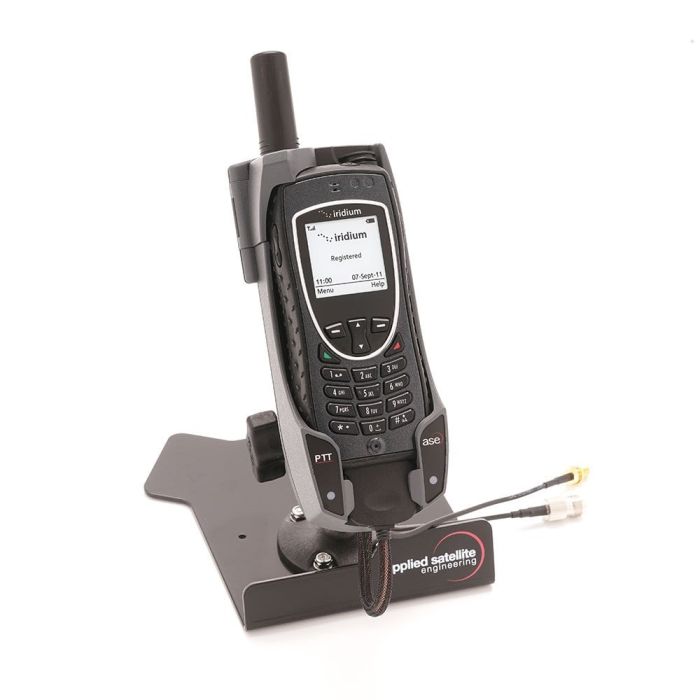
ASE 9575 Extreme / PTT Headquarters Docking Station with POTS, Office / HQ (ASE-9575P-HQ)
In stock
- BRAND:
- ASE
- PART #:
- ASE-9575P-HQ
- ORIGIN:
- United States
- AVAILABILITY:
- USUALLY SHIPS IN 3-5 BUSINESS DAYS
- SKU:
- ASE-9575P-HQ-PTT-DOCK
ASE 9575 Extreme / PTT Headquarters Docking Station with POTS, Office / HQ (ASE-9575P-HQ)
Docking stations like the ASE-9575P-E1 address a practical constraint of handheld satellite phones: reliable day-to-day calling from inside vehicles, buildings, and wheelhouses usually requires a fixed mounting point, continuous power, and an external antenna path. ASE positions the 9575 Extreme Dock as an indoor/outdoor solution: dock the phone for installed use, and undock the handset when portability is needed.
Design and Features
Rugged cradle with latching restraint
The ASE Extreme Dock is designed to securely lock the Iridium 9575 handset in place and provide a latching connection intended to reduce the effects of vibration—an important consideration for vehicles, vessels, and mobile command platforms. Some dealer descriptions emphasize that the dock exposes handset ports/buttons while docked, including access to the 9575’s SOS button.
External speaker + palm-held PTT microphone (E1 configuration)
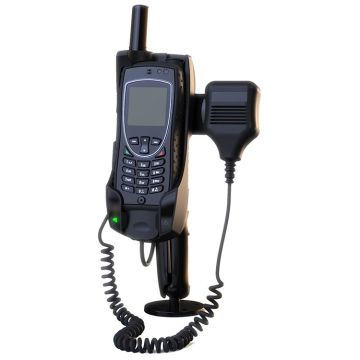
The defining feature of the ASE-9575P-E1 configuration is its external audio package, described as a “unique to the industry palm held speaker/mic with push-to-talk (PTT) operation.” Dealers position this as a familiar workflow for users who already rely on PTT-style audio accessories (public safety, security, field operations).
Multiple voice interface options (beyond the E1 bundle)
While the E1 model highlights the palm-held PTT speaker/mic, product listings and the docking-station user guide describe additional compatible voice interfaces, including:
-
a standard full-duplex mic and speaker for hands-free in-vehicle operation, and
-
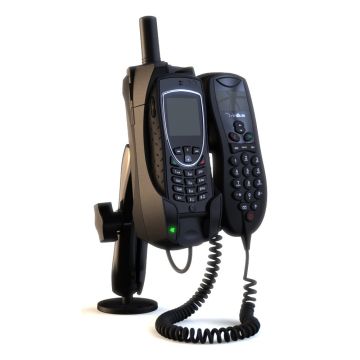
a corded privacy/“intelligent” handset connected via RJ-45 (one handset supported).
In other words, the dock is commonly treated as a platform that can be configured for different operational workflows, from vehicle hands-free calling to desk/office handset calling.
Optional RJ-11 analog phone / PABX integration (model-dependent)
The ASE 9575 docking-station manual documents an RJ-11 analog phone / PABX interface as an optional connection (noted as “9575P only” in the manual), enabling satellite voice to be presented like a landline wall jack for analog phones or PBX trunk/CO integration. The manual includes an explicit warning: the dock emulates a landline wall jack and generates required voltages, and it should be connected to a PBX as a CO/trunk line, not as an extension, to avoid damage.
SmartDial dialing workflow
ASE’s docking-station user guide includes “Calling With SmartDial” and “Calling Without SmartDial” sections, indicating the dock can assist with dialing workflows when using RJ-11 and/or the corded handset. This is intended to reduce friction for users who expect conventional dialing behavior.
Technology and Specifications
Antenna interfaces
The docking-station manual specifies two external antenna connector types:
-
Iridium antenna: male TNC
-
GPS antenna: male SMA
This reflects a typical installed architecture: an external Iridium antenna with clear sky view for satellite connectivity, and an optional GPS antenna for location-enabled variants or accessory functions (depending on configuration and system design).
Common connection points
The manual’s overview page identifies typical interfaces used across docking-station configurations, including:
-
External antenna(s)
-
Mini USB (noted as optional except for data connectivity)
-
RJ-11 (for analog phone/PABX where supported)
-
RJ-45 (behind corded handset; for the corded intelligent handset)
-
Power input
Installation and safety notes
Beyond general RF and vehicle safety guidance, the manual includes practical installation notes such as keeping cable splices to a minimum and not exceeding cable length guidance referenced in troubleshooting sections. It also emphasizes “finger-tight” connector tightening to avoid damaging connector housings.
Applications and Use Cases
First responders, security, and field operations
Dealer descriptions explicitly frame the palm-held PTT speaker/mic as familiar to first responders and security personnel, making the E1 configuration suitable for organizations that prefer PTT ergonomics while still requiring Iridium satellite coverage.
Vehicle-based satellite communications
The “external mic/speaker” and PTT accessory approach aligns naturally with in-vehicle use—fleet trucks, emergency vehicles, and mobile command platforms—where operators need reliable satellite voice without handling the handheld phone.
Remote sites and business continuity
Docking-station architectures are also used in remote offices, mining camps, utility depots, and field bases, where a docked Iridium phone serves as a resilient backup to cellular networks. The manual’s “dock indoors / undock and go” model supports mixed indoor-field workflows.
Marine and offshore environments
Although the E1 configuration is often marketed around vehicle/public safety workflows, the same installed cradle concept is relevant in marine and offshore settings where vibration and operator ergonomics matter, and where external antennas provide consistent connectivity from enclosed spaces.
Advantages / Benefits
Faster “grab and talk” operation vs handheld-only use
A docked Iridium 9575 can remain mounted and connected to power and antennas, reducing time-to-call in urgent situations. The external speaker/mic provides a practical interface without forcing the user to hold and position the handset.
PTT ergonomics for high-noise or high-workload situations
The palm-held PTT audio format is widely understood in operational environments. It can reduce cognitive load and improve call handling when users are driving, working equipment, or coordinating teams under stress.
Expandable voice options and optional PBX integration
Beyond the E1 audio kit, the platform supports other voice interfaces (hands-free mic/speaker, privacy handset) and, where the 9575P option applies, RJ-11 integration for analog phone/PBX trunk connectivity—useful for sites that want satellite voice to behave like an office line.
Installation transparency through published documentation
The availability of an installation/user guide with explicit wiring cautions and connector specifications supports predictable integration for professional installers and fleet operators.
FAQ Section
What is ASE-9575P-E1?
ASE-9575P-E1 is an ASE docking station for the Iridium 9575 Extreme that enables installed operation and includes an external speaker and palm-held PTT speaker/microphone for hands-free or push-to-talk calling workflows.
How does the ASE 9575 Extreme docking station work?
You dock the Iridium 9575 Extreme into the cradle, which secures the handset and provides installed interfaces (power, antennas, and optional audio/telephony connections). The E1 bundle adds external audio so calls can be handled without relying on the handheld’s built-in speaker and mic.
Why is ASE-9575P-E1 important?
It improves the practicality of Iridium satellite voice in vehicles, remote sites, and operational environments by providing a secure mount, external antennas, and PTT-style audio interfaces familiar to field users.
What are the benefits of ASE-9575P-E1?
Commonly cited benefits include PTT ergonomics, support for multiple voice interfaces, installed antenna connectors (TNC for Iridium and SMA for GPS), and optional RJ-11/PABX integration on supported configurations.
Can I connect the dock to a PBX?
The docking-station manual states the dock can emulate a landline wall jack and generate ringing/operating voltages, and it warns that PBX connections should be made as CO/trunk line, not as an extension, to avoid damage.
Summary
The ASE-9575P-E1 is a professional docking solution that transforms the Iridium 9575 Extreme handheld into an installed satellite communications station optimized for rugged environments. By combining a locking cradle, external antenna connectivity (TNC for Iridium and SMA for GPS), and an external speaker plus palm-held PTT speaker/mic, it targets real-world operational needs in fleet vehicles, security/public safety workflows, marine/offshore operations, and remote-site business continuity—where fast access to reliable satellite voice matters more than handheld convenience.
Specifications
| PART # | ASE-9575P-HQ |
|---|---|
| PRODUCT TYPE | SATELLITE PHONE |
| USAGE AREA | 100% GLOBAL |
| BRAND | ASE |
| NETWORK | IRIDIUM |
| SERVICE | IRIDIUM VOICE |
| USE TYPE | FIXED, MARITIME, VEHICULAR |
| ACCESSORY TYPE | DOCKING STATION |
| COMPATIBLE WITH | IRIDIUM 9575 EXTREME, IRIDIUM PTT |
| HARMONIZED TARIFF NUMBER | 85177900 |
| LENGTH | 33 cm |
| WIDTH | 15 cm |
| DEPTH | 11.5 cm |
| WEIGHT | 1.6 kg |
Related Products
Out of stock
Out of stock

Out of stock