
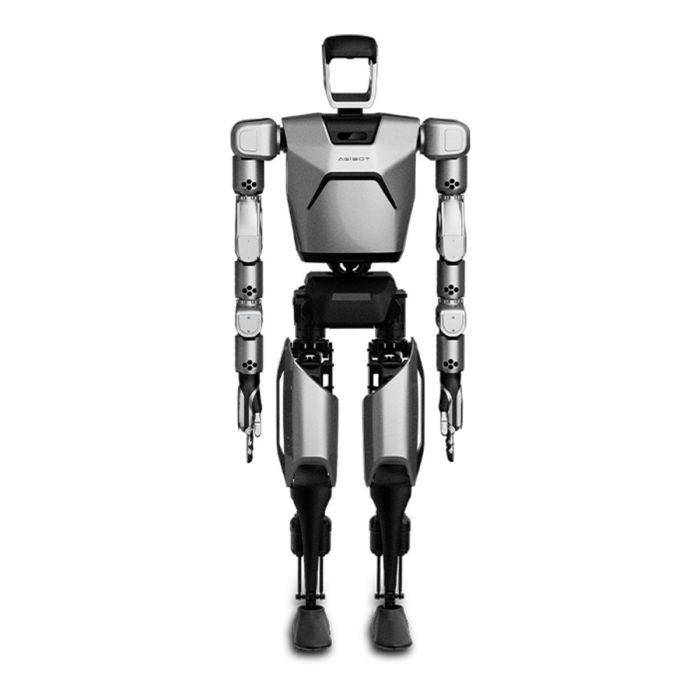
AgiBot A2 Max Heavy-Duty Special-Purpose Humanoid Robot (Coming Soon)
Disponible
- MARCA:
- AGIBOT
- NÚMERO DE PIEZA #:
- AgiBot A2 Max
- ORIGIN:
- China
- DISPONIBILIDAD:
- SUBJECT TO AVAILABILITY
- SKU:
- AgiBot-A2-Max
AgiBot A2 Max Heavy-Duty Special-Purpose Humanoid Robot: Full Guide
Within AgiBot's A2 Series, the A2 Max occupies the industrial heavy-duty tier: it is taller and significantly heavier than the standard A2 (85 kg versus 69 kg), carries more than twice the payload capacity (40 kg versus 15 kg per arm), produces substantially higher joint torque (450 Newton-meters versus the standard arm torque), and offers the highest degree-of-freedom count in the A2 family at 67 degrees of freedom across the full body. These specifications position the A2 Max as a bipedal humanoid robot with strength metrics oriented toward tasks in logistics, warehousing, and manufacturing that currently require human labor due to load weight requirements beyond what lighter service robots can handle.
Design and Physical Features
Body Dimensions and Structural Design
The A2 Max stands 175 centimeters tall and weighs 85 kilograms. In comparison to the standard A2, which stands at approximately 169 centimeters and weighs 69 kilograms, the A2 Max is 6 centimeters taller and 16 kilograms heavier. The additional mass is distributed across a reinforced structural frame designed to carry and transfer the higher loads produced by its 40-kilogram payload rating.
The greater height of the A2 Max — 175 centimeters versus the standard A2's 169 centimeters — provides a longer arm reach envelope for accessing objects at varying heights, from floor level to elevated shelving, without requiring the robot to stand on its toes or adopt unstable postures. Combined with the waist's three degrees of freedom for squatting and bending, the A2 Max can access objects across a full vertical range comparable to a working human.
The robot's dual arms are built on the same seven-degrees-of-freedom kinematic architecture as the standard A2, but with substantially upgraded actuation — dual-ratio reduction joint modules rather than the single-ratio system of the standard model, enabling the much higher peak torques required for industrial load handling.
Arm System and Payload Capacity
The dual arms of the A2 Max are equipped with dual-ratio reduction joint modules, delivering peak torque of up to 450 Newton-meters. This is the arm's most important performance differentiator relative to the standard A2, and it is the mechanical basis for the 40-kilogram payload capacity. The two arms working in coordination — bimanual lifting — allow the robot to handle objects that fall within or near the maximum single-human lift limit, covering a range of standard industrial packages, components, and sub-assemblies that current logistics facilities move by human workers.
Each arm retains seven degrees of freedom, providing the same kinematic range of motion as the standard A2 arm. This means the A2 Max does not sacrifice reach or articulation for strength — it is designed to be both strong and dexterous, enabling it to handle objects that require controlled approach, gripping from multiple angles, and precise placement rather than simple brute-force lifting.
Dexterous Hands
The A2 Max is equipped with the same 19-degrees-of-freedom industrial-grade dexterous hands (12 active degrees of freedom) used across the A2 family. These hands offer flexibility comparable to human hands, providing the fine manipulation capability needed to grip standard industrial packaging formats, handles, and irregular load shapes without requiring custom gripper tooling for each item type. The 12 active degrees of freedom include full finger articulation comparable to the human hand, supporting both power grasps for secure load holding and fingertip grasps for precise placement of loads into fixtures or onto pallets.
Waist and Lower Body
The A2 Max's three-degrees-of-freedom waist enables the robot to squat and bend to pick up items from the ground — a functional requirement for loading from floor-level storage and unloading from ground-level conveyors. With 7 degrees of freedom in the arms, 6 in the legs, and 3 in the waist, the robot can reach across its full working range including the floor, making it practical for the full vertical range of material handling tasks rather than only those within comfortable standing reach.
The leg joints use linear actuator motors in the thighs, which the A2 Max specification identifies as providing 8,800 Newtons of thrust. This leg thrust specification supports stable locomotion and posture under load — the robot must maintain balanced bipedal walking while carrying up to 40 kilograms in its arms, a significant mechanical demand that the linear actuator leg design addresses through the higher force output compared to rotary-only joint designs.
Technology and Specifications
Core Specifications at a Glance
| Specification | Value |
|---|---|
| Height | 175 cm |
| Weight | 85 kg |
| Total Degrees of Freedom | 67 |
| Hand Degrees of Freedom | 19 (12 active) |
| Arm Degrees of Freedom | 7 per arm |
| Leg Degrees of Freedom | 6 per leg |
| Waist Degrees of Freedom | 3 |
| Maximum Payload | 40 kg |
| Peak Arm Joint Torque | 450 Nm |
| Leg Joint Thrust | 8,800 N |
| Walking Speed | 1 m/s |
| Turning Radius | 60 cm |
| Battery Runtime | 2 hours |
| Battery System | Swappable |
| Actuation (arms) | Dual-ratio reduction joint modules |
| Actuation (legs) | Linear actuator motors |
AI and Software Platform
The A2 Max shares the A2 Series' core AI technology stack with its sibling models. This includes the GO-1 foundation model (Genie Operator-1), AgiBot's generalist embodied AI system that uses the Vision-Language-Latent-Action (ViLLA) framework to interpret natural-language instructions, perceive the environment through visual and sensor data, plan multi-step manipulation tasks, and execute precise physical operations.
For material handling and palletizing applications, GO-1's task planning capability is particularly relevant. Rather than executing rigid, pre-programmed pick-and-place sequences, the A2 Max's AI system can understand higher-level task descriptions ("stack these boxes on that pallet") and generate appropriate grasp sequences, approach angles, and placement patterns autonomously, adapting to variations in box orientation, position, and stack configuration.
The WorkGPT multimodal AI engine provides voice command understanding, environmental awareness, and operator communication. The AimRT middleware handles real-time communication between the robot's sensors, joints, and compute with low latency. These systems, developed across the full A2 Series, provide the A2 Max with the same software infrastructure as the service-oriented A2 Ultra, even though the A2 Max's primary focus is industrial strength rather than customer-facing interaction.
Mobility and Navigation
The A2 Max walks at a maximum speed of 1 meter per second — considerably slower than the standard A2's maximum of 3.3 m/s — reflecting the engineering tradeoffs involved in building a robot designed to carry 40-kilogram loads. The 60-centimeter turning radius is a practical specification for industrial facilities where the robot must navigate between pallets, racks, and conveyor lines in aisles that are typically 80 to 120 centimeters wide in a standard warehouse.
The robot's mobility is supported by L4-level autonomous navigation using the HIMUS 3D-SLAM and VectorFlux planning algorithms, enabling the robot to plan globally optimal trajectories, avoid dynamic obstacles — including moving forklifts and human workers — and navigate complex factory floor layouts without requiring floor-mounted track guidance.
The two-hour battery runtime with swappable battery support provides operational continuity across standard industrial tasks, with the swap capability enabling shift-length deployment when managed with a battery rotation schedule.
Applications and Use Cases
Material Handling
Material handling — moving components, sub-assemblies, finished goods, and packaging materials between production stages, storage areas, and loading zones — is the primary target application for the A2 Max. The robot's 40-kilogram payload capacity, bimanual grip, and dexterous hands enable it to handle the range of standard industrial load sizes and shapes without requiring custom fixtures or specialized grippers for each item type.
In manufacturing environments, material handling tasks include feeding components from storage to assembly workstations, moving work-in-progress between production stages, clearing finished goods from production areas to staging zones, and managing the supply of raw materials to process equipment. These tasks are currently performed largely by human workers in facilities that cannot justify full fixed conveyor or automated guided vehicle investments for their specific material flow patterns.
Palletizing
Palletizing — stacking goods onto pallets in specified patterns for storage or shipping — is one of the most physically demanding and repetitive tasks in logistics and manufacturing. The task requires controlled lifting of loads (typically 10 to 25 kilograms per unit for standard consumer goods cartons), precise placement to maintain pallet stability, and the ability to build a stack through multiple layers with changing reach requirements as the pallet height increases. The A2 Max's 40-kilogram payload, seven-DOF arms with 450 Nm torque, and full-body squatting capability enable it to execute palletizing tasks across the full vertical range of a standard pallet stack from floor level to approximately 1.8 meters high.
AgiBot specifically identified palletizing as a primary use case in the A2 Max's product positioning, making it one of the few companies explicitly targeting humanoid robots at this widely deployed but labor-intensive logistics task.
Warehouse Operations
Beyond palletizing, the A2 Max's strength and bipedal mobility make it suitable for a range of warehouse operations including depalletizing (unloading incoming pallet stacks), tote and carton handling on pick-and-pack lines, inventory restocking to high shelves, and inter-zone transport of standard load units. The bipedal form factor enables the A2 Max to navigate warehouse environments designed for humans — including the use of existing elevator systems, aisle layouts, and workstation heights — without requiring the facility modifications that fixed automation or AGV systems often demand.
Manufacturing Loading and Unloading
In manufacturing environments, loading and unloading operations between machines, conveyor systems, and storage buffers often require human workers because the loads are heavy, the orientations are variable, and the positions are not fixed precisely enough for rigid automation. The A2 Max's combination of high payload capacity, dexterous hands, and AI-driven adaptability makes it a candidate for these roles in facilities where the load characteristics are within the robot's capability envelope.
Advantages and Benefits
Industry-Highest Payload in the A2 Series: At 40 kilograms, the A2 Max's payload capacity is more than double the standard A2's 15-kilogram limit, opening material handling and palletizing applications that the service-oriented variants cannot address.
Highest DOF in the A2 Family: With 67 total degrees of freedom, the A2 Max offers the greatest kinematic range in the A2 Series, providing full-body squatting, arm reach across the complete working envelope, and dexterous hand manipulation — all in a single integrated platform without sacrificing articulation for strength.
Bipedal Form Factor for Unmodified Facility Navigation: Unlike wheeled industrial robots, the A2 Max can navigate stairs, curbs, ramps, and multi-floor industrial facilities using standard human infrastructure — elevators, walkways, ramps — without requiring facility modifications for robot transit.
Bimanual Coordination for Complex Loads: The dual-arm system's coordination capability enables the robot to handle awkward, bulky, or irregularly shaped loads that require two-handed gripping, controlled tilt, and synchronized arm movement — tasks that single-arm industrial robots cannot perform without specialized fixtures.
Linear Actuator Leg Design for Load Stability: The linear actuator motors in the thigh joints provide 8,800 Newtons of leg thrust, designed specifically for the stability demands of carrying 40-kilogram payloads during bipedal walking — a mechanical design choice that distinguishes the A2 Max from lighter-duty humanoids whose leg systems were not engineered for this load level.
Shared AI Ecosystem with the Broader A2 Series: The A2 Max benefits from the GO-1 foundation model, AimRT middleware, and AgiBot World training dataset improvements applied across AgiBot's full robot portfolio — meaning AI capability advances that AgiBot develops for its humanoid robots broadly apply to the A2 Max without requiring separate model development.
Comparison Within the A2 Family
| Feature | A2 (Standard) | A2 Max | A2 Ultra | A2-W |
|---|---|---|---|---|
| Height | ~169 cm | 175 cm | ~169 cm | 163 cm |
| Weight | ~55 kg | 85 kg | ~69 kg | ~230 kg |
| Total DOF | 40+ | 67 | 40 | 22 (waist/arms) |
| Max Payload | 15 kg | 40 kg | ~3 kg (light) | 5 kg/arm |
| Mobility | Bipedal | Bipedal | Bipedal | 4WD wheeled |
| Primary Use | Service/HRI | Heavy industrial | Commercial service | Factory floor |
| Battery | 700 Wh, ~2h | ~2h + swap | Hot-swap | 2,000 Wh, 5h |
| Availability | Available | Coming Soon | Available | Available |
The A2 Max is the only bipedal member of the A2 family designed for heavy industrial payload, setting it apart from the service-oriented A2 and A2 Ultra models. The wheeled A2-W addresses a similar industrial audience but with a wheeled base suited to flat factory environments, while the A2 Max's bipedal locomotion enables it to navigate unstructured industrial facilities that include stairs, ramps, and multi-level layouts.
Frequently Asked Questions (FAQ)
What is the AgiBot A2 Max? The AgiBot A2 Max (AGIBOT A2-Max) is a full-size heavy-duty bipedal humanoid robot developed by AgiBot specifically for industrial material handling and palletizing applications. It stands 175 centimeters tall, weighs 85 kilograms, and features 67 total degrees of freedom. Its dual arms deliver peak joint torque of 450 Newton-meters using dual-ratio reduction joint modules, enabling a maximum payload of 40 kilograms. The leg joints use linear actuator motors providing 8,800 Newtons of thrust for load-carrying stability during bipedal walking. As of April 2026, the A2 Max is listed as "Coming Soon" on AgiBot's official product page.
How does the AgiBot A2 Max work? The A2 Max uses bipedal locomotion with six-DOF legs powered by linear actuator thigh motors and a three-DOF waist for squatting and bending, enabling it to handle loads across the full vertical working range from floor level upward. Its dual seven-DOF arms, equipped with dual-ratio reduction joint modules at up to 450 Nm peak torque, lift and position loads up to 40 kilograms. The 19-DOF dexterous hands (12 active) grip standard industrial packaging formats without custom tooling. The GO-1 foundation model provides task planning from natural-language instructions, and AimRT middleware coordinates real-time sensor, compute, and actuator communication. The robot navigates autonomously using HIMUS 3D-SLAM and VectorFlux planning algorithms at up to 1 m/s.
What makes the AgiBot A2 Max different from the standard A2? The A2 Max is specifically engineered for heavy industrial load handling, while the standard A2 is optimized for service interaction and light manufacturing. The key differences are: payload capacity (40 kg versus 15 kg), total degrees of freedom (67 versus 40+), body weight (85 kg versus 55-69 kg), height (175 cm versus 169 cm), arm actuation (dual-ratio reduction modules at 450 Nm versus single-ratio at lower torque), and leg actuation (linear actuator motors at 8,800 N thrust versus standard rotary joints). The standard A2 prioritizes dexterity, lightweight construction, and service interaction AI; the A2 Max prioritizes strength, structural rigidity, and load-handling capability.
When will the AgiBot A2 Max be available for purchase? As of April 2026, the AgiBot A2 Max is listed as "Coming Soon" on AgiBot's official product page (agibot.com/products/A2_Max), without a confirmed public release date. AgiBot demonstrated the robot's capability at its August 2024 product launch event, where it moved a 40-kilogram aviation box using its dual-arm system. The specifications are published, and enterprise buyers can register interest through AgiBot's contact form on the A2 Max product page. Pricing has not been publicly announced. Given AgiBot's production velocity — shipping over 5,000 robots in 2025 — the A2 Max's commercial release timeline is best monitored through AgiBot's official channels.
What are the main applications for the AgiBot A2 Max? The A2 Max is designed primarily for material handling and palletizing in industrial, warehousing, and logistics environments. Specific applications include stacking and destacking loads on pallets, moving components and finished goods between production stages, loading and unloading from conveyors and machines, warehouse restocking operations, and any material handling task involving loads up to 40 kilograms in a factory or warehouse environment. The bipedal form factor enables the A2 Max to use standard human infrastructure including elevators, ramps, and multi-floor facility layouts without requiring environmental modification.
How does the AgiBot A2 Max compare to the A2 Ultra? The A2 Max and A2 Ultra serve fundamentally different purposes within the A2 Series. The A2 Ultra is the commercial service flagship, optimized for exhibitions, reception, guided tours, and brand activations — it offers 40 DOF, triple-market regulatory certification, validated 1,300-hour walking endurance, and customizable interaction software. The A2 Max is the heavy industrial variant, optimized for load-carrying tasks — it offers 67 DOF, 40-kilogram payload, 450 Nm arm torque, and 8,800 N leg thrust. The A2 Ultra prioritizes human-facing service quality and reliability; the A2 Max prioritizes structural strength and industrial load capacity. The A2 Ultra is commercially available; the A2 Max is listed as Coming Soon.
Summary
The AgiBot A2 Max Heavy-Duty Special-Purpose Humanoid Robot represents the highest-strength configuration in AgiBot's bipedal humanoid lineup, engineered specifically to bring humanoid robot capability to the material handling and palletizing tasks that currently demand human workers due to their load weight requirements. With 67 degrees of freedom across the full body, 450 Newton-meters of peak arm torque, 8,800 Newtons of leg thrust, and a 40-kilogram maximum payload — demonstrated publicly by lifting an aviation box at AgiBot's August 2024 launch — the A2 Max is technically positioned to address one of the most commercially significant near-term applications for general-purpose humanoid robots in logistics and manufacturing. While the robot remains in a "Coming Soon" status as of April 2026, its specifications and public demonstrations indicate a mature design backed by AgiBot's production-scale manufacturing capabilities and the company's proven track record of transitioning robot models from announcement to commercial deployment. Organizations planning industrial robotics strategies for 2026 and beyond should monitor the A2 Max's commercial release closely.
Specifications
General
What's included
Artículos relacionados
No está disponible