
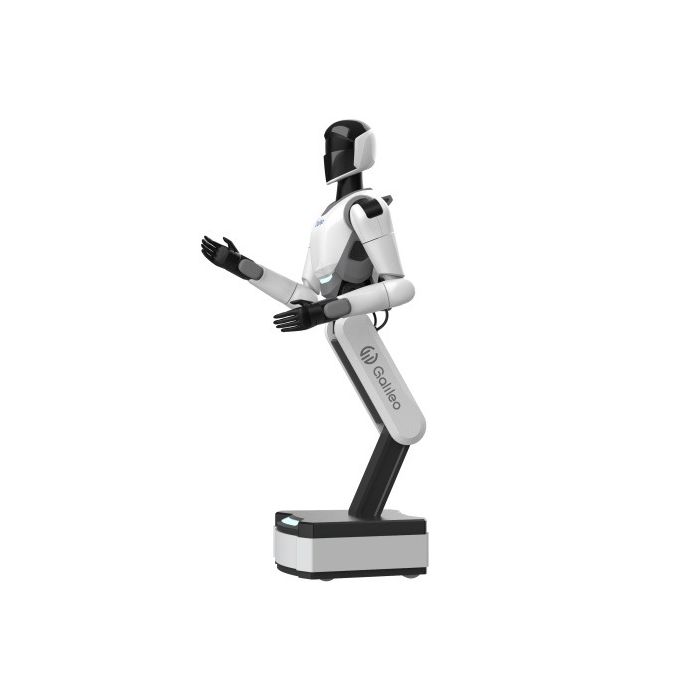
Galileo SH1 Dual Arm Wheeled Humanoid Robot
Disponible
- MARCA:
- GALILEO
- MODELO:
- SH1
- ORIGIN:
- China
- Warranty:
- 12 MESES
- DISPONIBILIDAD:
- SUBJECT TO AVAILABILITY
- SKU:
- GALILEO-SH1
Galileo SH1 Dual Arm Wheeled Humanoid Robot
Walking is the hardest thing a humanoid does, and much useful work doesn't need it. Factory floors, warehouses, labs, hospitals and shops are flat. The Galileo SH1 is built around that fact. It puts a human-like upper body with two arms on a wheeled mobile base, and it spends its engineering budget on what matters for handling objects. It has an NVIDIA Jetson AGX Orin computer rated at 275 TOPS, a perception suite of cameras, LiDAR and ultrasonic sensors, force sensing at both wrists, and hands that can be swapped for the job. At 172 cm and 80 kg, the SH1 works at human height and reaches the shelves, benches and machines people already use. It runs for about four hours per charge.
Background and Manufacturer
Galileo (Tianjin) Technology develops embodied intelligence robots and builds its core components and motion-control software in-house. The company is best known for its C1, E1 and S1 industrial quadrupeds. Its catalog also includes two robots with a human-like form. The GH1 is a fully bipedal humanoid with 31 degrees of freedom for whole-body mobility research. The SH1 takes the wheeled route and focuses on mobile manipulation, meaning tasks where a robot travels to a location and then uses two arms to work there. Galileo positions it for industrial and service scenarios.
Design and Engineering
Upper body and arms
The SH1 has 24 degrees of freedom, spread through a dual-arm upper body that reaches, grasps and works with objects at human working height. Each arm handles up to 5 kg. That covers totes, parts, tools, packages and most everyday objects. Two six-axis force/torque sensors at the wrists measure contact force in every direction. That lets the robot insert, press, wipe and hand objects over under control instead of by position alone.
Interchangeable end effectors
Buyers choose the hands to suit the application:
- 2-finger gripper for robust, repeatable picking of parts and packages.
- 3-finger dexterous hand, with or without tactile sensing, for adaptive grasps of varied objects.
- 5-finger dexterous hand for the most human-like manipulation and for research into dexterous skills.
Perception
The sensor suite gives the robot views at close and long range:
- Binocular camera for stereo vision of the scene ahead.
- 2 depth cameras for 3D perception of objects and the workspace.
- 4 RGB cameras for visual coverage around the robot.
- 3D LiDAR on the chassis for mapping, localization and navigation.
- 8 ultrasonic sensors for detecting close obstacles, including glass and other surfaces that cameras and LiDAR can miss.
- 3 IMUs for motion and orientation sensing.
Computing and software
An NVIDIA Jetson AGX Orin module with 64 GB of memory and 275 TOPS of AI performance runs perception, navigation, manipulation planning and AI models on the robot itself. The SH1 supports over-the-air updates and secondary development, so research teams and integrators can build their own skills and applications. It can run autonomously or be teleoperated. Teleoperation is useful for collecting demonstration data to train manipulation policies.
Wheeled base
The mobile base moves at up to 1.5 m/s on flat indoor floors. Because it has no balance to manage, the robot stays stable while its arms are loaded and extended. It also needs no fall protection during trials, and the battery can go to computing and manipulation instead of walking. The tradeoff is that the SH1 can't climb stairs or cross rough ground. Galileo's GH1 and its legged quadrupeds cover those environments.
Power and connectivity
Runtime is about four hours, and the charger accepts 100 to 240 V input. Ethernet, Wi-Fi 6 and Bluetooth 5.3 connect the robot to site networks, development machines and peripherals.
Technical Specifications
| Parameter | Galileo SH1 |
|---|---|
| Robot type | Dual-arm wheeled humanoid |
| Height (standard pose) | 1,720 mm |
| Weight | 80 kg |
| Total degrees of freedom | 24 |
| Maximum arm payload | 5 kg per arm |
| Wrist sensing | 2 × six-axis force/torque sensors |
| End effector options | 2-finger gripper; 3-finger dexterous hand (tactile or non-tactile); 5-finger dexterous hand |
| Cameras | Binocular camera, 2 × depth, 4 × RGB |
| Navigation sensors | 3D LiDAR (chassis), 8 × ultrasonic |
| Inertial sensing | 3 × IMU |
| Computing | NVIDIA Jetson AGX Orin, 64 GB, 275 TOPS |
| Base | Wheeled mobile base |
| Movement speed | Up to 1.5 m/s |
| Runtime | About 4 hours |
| Charging input | 100 to 240 V |
| Connectivity | Ethernet, Wi-Fi 6, Bluetooth 5.3 |
| Operation | Autonomous and teleoperated |
| OTA updates | Supported |
| Secondary development | Supported |
| Warranty | 12 months |
SH1 or GH1?
Choose the SH1 when the work happens on flat floors and the goal is handling objects. It has more sensors, much more onboard computing, wrist force sensing and a stable base that holds its posture under load. Choose the GH1 when bipedal motion itself is the point, as in locomotion research, whole-body control, or environments with steps and thresholds that wheels can't cross.
Who It Is For
- Embodied AI labs collecting teleoperation data and training manipulation models on a robot built for long, repeatable sessions.
- Manufacturers trialing robots at workstations for loading, kitting, sorting and assembly support.
- Logistics and warehouse operators handling totes, parcels and items at shelves and conveyors.
- Service operators in retail, healthcare and hospitality looking at restocking, delivery and guest assistance.
- Universities and integrators developing custom mobile manipulation applications on open, upgradable hardware.
Applications
Material handling and kitting: Picking parts and items from shelves and bins and placing them at workstations.
Machine tending and workstation support: Loading and unloading equipment, operating controls and supporting assembly, with force-controlled contact.
Retail and inventory: Restocking shelves, checking stock and handling goods in shops and storerooms.
Laboratory automation: Moving samples, operating instruments and handling containers between benches.
Manipulation research: Training dexterous skills with three hand options and comparing gripper, tactile and five-finger approaches on one platform.
Support: From First Inquiry to Long-Term Service
Before you buy: Support starts with the work itself: the objects, weights, heights and floor layout, the end effector the task needs, and the software and data workflow. The review confirms the SH1 is the right platform, then sets the hand choice, accessories and integration scope before a quote is issued.
Setup and commissioning: The robot ships with manufacturer documentation. First start covers charging, arm and sensor calibration, mapping the site with the LiDAR, network and Bluetooth setup, and checking the chosen end effector.
Training: Operators learn safe operation around people, teleoperation, task execution, charging and daily checks. Developers learn the Orin computing environment, the sensor data streams, secondary development tools and OTA update management.
Deployment: Deployment support covers site mapping, defining work cells and routes, task programming, collecting demonstration data, and connecting the robot to warehouse, production or research systems.
Ongoing service: The SH1 carries a 12-month manufacturer warranty. Technical help, software and OTA updates, replacement end effectors and spare parts stay available for the life of the robot.
Pricing and Availability
The Galileo SH1 is sold on quotation. The final cost depends on the end effector choice, tactile options, accessories, the scope of training and integration, the delivery destination and import duties. Every unit is sourced through the manufacturer's official channels and comes with full manufacturer warranty, documentation and technical support. You can request quotes for single robots, lab setups and fleet orders on this page.
Frequently Asked Questions
What is the Galileo SH1?
It is a dual-arm wheeled humanoid from Galileo (GalileoTime) for mobile manipulation in industrial, logistics, service and research settings.
How much can each arm lift?
Each arm handles up to 5 kg, and six-axis force/torque sensors at the wrists measure contact force.
What hands are available?
You can choose a 2-finger gripper, a 3-finger dexterous hand with or without tactile sensing, or a 5-finger dexterous hand.
What computing does the SH1 use?
It runs on an NVIDIA Jetson AGX Orin with 64 GB of memory and 275 TOPS of AI performance.
How long does the battery last?
About four hours per charge. The charger works on 100 to 240 V mains power.
Can the SH1 climb stairs?
No. Its wheeled base is designed for flat indoor floors. For stairs and rough terrain, Galileo offers the bipedal GH1 and its legged quadrupeds.
Where can I buy the Galileo SH1 and what does it cost?
You can buy the Galileo SH1 right here. The price depends on configuration, end effectors, integration and delivery destination, and you can request a quote for your project on this page.
Summary
The Galileo SH1 puts its effort into handling objects. It combines a 24-DoF dual-arm upper body, interchangeable grippers and dexterous hands, six-axis wrist force sensing, a perception suite of cameras, LiDAR and ultrasonic sensors, and 275 TOPS of onboard AI computing on a stable wheeled base. For factories, warehouses, service operators and AI labs working on flat floors, it is a practical platform for mobile manipulation and for collecting the data that trains it.